


Introduction
Understanding eviction patterns helps communities, policymakers, and individuals protect housing stability and economic well-being. One important piece of data is the Idaho Policy Institute Formal Eviction Rate 2020 Shoshone County, which highlights how many renters were legally removed from their homes in a small rural county during a year marked by economic disruption, court closures, and federal protections. The data from Idaho Policy Institute provides critical insights not only into statewide housing trends but also into how local conditions — such as employment, housing supply, rental affordability, and support services — impacted eviction outcomes.
In this article, we unpack the latest available data, explain what the eviction rate means, compare Shoshone County to the rest of Idaho, and explore what these findings mean for residents and policymakers in 2026. You’ll also find a helpful table that summarizes key figures from 2020 and more recent updates on eviction trends across the state.
What Is the Idaho Policy Institute and Why It Matters
The Idaho Policy Institute (IPI) at Boise State University is a public policy research center that compiles and analyzes eviction data from the Idaho Supreme Court’s records. This data is considered one of the most complete sources of information on eviction activity within the state. It tracks court filings and formal eviction orders across all 44 counties, including rural areas such as Shoshone County.
A formal eviction — as opposed to an eviction filing — occurs when a judge issues a court order for a tenant to vacate a residence. Not all eviction filings result in formal orders, which is why the formal eviction rate is an important measure of actual housing loss as opposed to mere legal action.
How Eviction Rates Were Measured in 2020
To calculate the Idaho Policy Institute Formal Eviction Rate 2020 Shoshone County:
- Researchers collected all unlawful detainer cases — the legal category for eviction — from Idaho’s court system.
- They excluded commercial evictions to focus solely on household displacement.
- They used census estimates to calculate the number of renting households.
- The eviction rate is then the number of households with formal eviction orders divided by the estimated total number of renter households in a county, expressed as a percentage.
Thus, the eviction rate measures not the volume of court activity but the proportion of renters who were legally ordered out of their homes by a judge.
Key Findings from 2020
In 2020, Idaho saw changes in eviction activity driven by the pandemic. Statewide, there was a significant drop in eviction filings and formal evictions compared to 2019, largely because courts temporarily shut down early in the pandemic and federal eviction moratoriums slowed processing.
Shoshone County in 2020
The Idaho Policy Institute Formal Eviction Rate 2020 Shoshone County shows that:

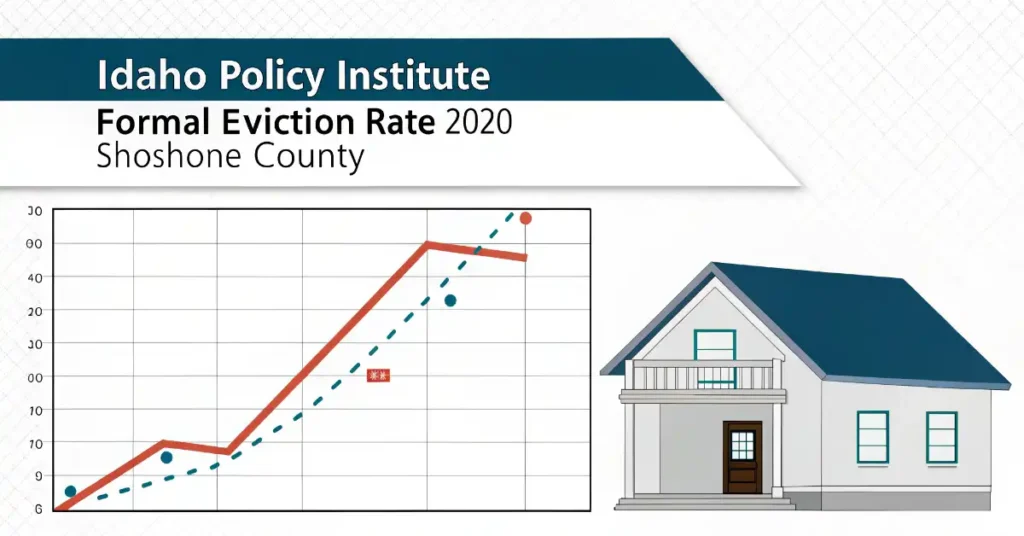
- Shoshone County had an estimated 1.10% formal eviction rate in 2020.
- This rate was nearly double Idaho’s statewide formal eviction rate of about 0.6% that year.
- Roughly 18 households were formally evicted from Shoshone County through court orders, out of around 1,642 renting households.
Put simply, about 1 in 90 renters in this rural county were ordered out of their homes by a judge during 2020.
This figure is particularly important for several reasons: Shoshone County has a smaller population, a rural economy heavily tied to mining and related industries, and limited access to legal aid or mediation services. These conditions can make renters more vulnerable to housing loss.
Severna Park High School Falcons: Athletic Season 2026
Comparing Shoshone County to Other Counties in Idaho
The table below highlights how Shoshone County’s eviction figures compared with statewide averages and selected counties for the same year.
Table: Eviction Data — Idaho 2020 vs. Shoshone County
| Region/County | Renter Households | Formal Evictions | Formal Eviction Rate |
| Idaho Statewide | ~189,292 households | ~1,127 formal evictions | ~0.6% |
| Shoshone County | ~1,642 households | ~18 formal evictions | 1.10% |
| Bannock County | – | – | 1.25% |
| Bingham County | – | – | 1.18% |
| Ada County | – | – | 0.40% |
| Canyon County | – | – | 0.72% |
Note: County numbers other than Shoshone and statewide estimates are included for context and to show variation across regions.
From this table, we can see that rural counties like Shoshone and Bannock had higher eviction rates than the statewide average, while larger counties with more rental assistance programs and mediation services tended to have lower formal eviction rates.
Why Did Shoshone County’s Eviction Rate Stand Out?
Despite lower absolute numbers of evictions, the percentage impact in Shoshone County was notable. Here are some reasons that researchers and analysts highlight:
1. Rural Economic Vulnerability
Shoshone County’s economy relies on industries like mining, forestry, and small-business service sectors, which were hit hard during the pandemic. When employment dropped, many renters struggled to cover rent, leading to a higher proportion of eviction orders relative to the number of renters.
2. Housing Market Characteristics
Rental inventory in rural counties is smaller and often limited. A constrained market means fewer options for displaced renters and a higher likelihood that landlords will pursue legal eviction when rent goes unpaid.
3. Lack of Local Mediation Programs
Unlike Ada County and other urban areas that implemented mediation programs to help tenants and landlords resolve issues without court orders, Shoshone County had limited access to such services in 2020. This raised the chance that a filing would result in a formal eviction.
4. Federal Moratoriums Had Uneven Reach
Federal eviction moratoriums during the pandemic helped slow eviction activity, but not all renters qualified or were aware of these protections. This uneven coverage meant that many households still faced eviction despite policy intentions.
Broader Impacts on Housing Stability
Evictions don’t just cause families to lose a roof over their heads — they have broader social and economic consequences.
1. Reduced Housing Stability
Even a modest eviction rate like 1.10% can destabilize local housing markets in rural areas where available rental units are already scarce and moving costs are high.
2. Credit and Mobility
A formal eviction judgment often shows up on tenant screening reports, making it harder for affected residents to rent elsewhere or secure stable housing in the future.
3. Community and Economic Costs
Higher eviction rates can strain local social services, increase homelessness risk, and reduce consumer spending in small communities. Rural areas with limited support networks feel these effects more sharply.
What Has Changed Since 2020? Insights into 2023–2025 Trends
Since 2020, eviction patterns in Idaho have shifted. According to the Idaho Policy Institute’s most recent information:
- Eviction activity increased in 2023 compared to 2022, with filings and formal evictions rising.
- The percentage of tenants losing in court dropped, indicating more cases are resolved through mediation or assistance.
- In statewide 2025 data, about 1.6% of renting households experienced at least one eviction filing, and around 0.6% faced formal eviction, showing eviction rates staying relevant but now tracked with more up-to-date numbers.
These trends show how eviction dynamics continue to evolve as housing markets tighten and support systems adapt.
Policy Implications & What This Means for Idaho
The Idaho Policy Institute Formal Eviction Rate 2020 Shoshone County highlights several policy opportunities:
1. Expand Legal Aid in Rural Areas
Legal representation and eviction defense services can help renters navigate eviction processes and possibly avoid formal judgments.
2. Increase Rental Assistance Outreach
Many tenants were unaware of available relief programs during the pandemic, suggesting a need for better communication and implementation, especially in rural counties.
3. Support Mediation Services
Programs that help tenants and landlords find middle ground before formal court involvement have been shown to reduce eviction rates in urban counties.
4. Improve Housing Supply
Long-term solutions involve building affordable rental housing so displaced renters have options and communities can maintain stability.
Conclusion
The Idaho Policy Institute Formal Eviction Rate 2020 Shoshone County offers a clear snapshot of how eviction affected a small rural community during one of the most turbulent years in modern U.S. history. With a 1.10% formal eviction rate in 2020 — nearly double the statewide average — Shoshone County’s data underscores the importance of localized eviction tracking, policy intervention, and housing support services for rural areas.
Students can check out the latest Updates Atholton News