



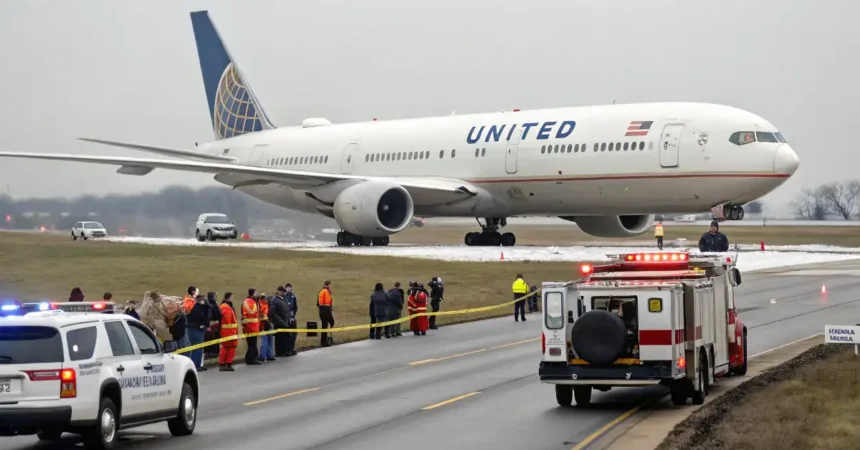
Search “United Airlines Flight UA770 emergency diversion,” and dozens of dramatic stories appear about a Boeing 787 squawking a mid-air emergency. We went hunting for the official record behind it.
There is not one. Here is what is verifiably real about United diversions, and what looks invented.
Key takeaways
- No airline statement, aviation regulator, or flight tracker shows any record of a UA770 emergency diversion. The trail leads only to AI-style content farms.
- Real United diversions are easy to confirm. In May 2026, flight UA2005 diverted to Madison, Wisconsin after a passenger tried to breach the cockpit, as reported by CNN.
- Quick test for any flight scare: check the Aviation Herald, Flightradar24, the FAA, and a major newsroom. If only blogs cover it, treat it as fiction.
Where did the UA770 story come from?
We reviewed the top search results for the keyword. Every one traces back to content-mill sites, not a newsroom or a regulator. The biggest tell is that the so-called facts do not agree with each other.
A genuine 787 emergency would appear on the Aviation Herald within hours and draw quick coverage from Reuters, the Associated Press, or the BBC. For UA770, none of that exists.
| Claimed detail | What the content sites say |
| Route | Barcelona to Chicago in most versions, a Los Angeles departure in others |
| Diverted to | London Heathrow, or Chicago, or Denver, depending on the article |
| Reported cause | Cabin pressurization, or a vague “sensor alert” |
| Oxygen masks | “Deployed” in some retellings, “did not deploy” in others |
| Primary source | None: no FAA, NTSB, Aviation Herald, or major newsroom |
It is part of a bigger AI-slop problem
UA770 is not a one-off. After the November 2025 UPS cargo crash in Louisville, AI-written articles and videos pushed false crash theories before investigators released anything, according to Louisville Public Media. Plane stories spread fast, and most readers never check the source.
Real United diversions you can actually verify
Genuine diversions happen often and leave a clear paper trail. Three recent, well-documented examples:
| Flight and date | Route | What happened | Diverted to | Reported by |
| UA2005, May 29, 2026 | Chicago (ORD) to Minneapolis (MSP) | Passenger tried to breach the cockpit; off-duty officers on board restrained him | Madison, WI (MSN) | CNN, Fox, FAA |
| UA236, May 2026 | Newark (EWR) to Palma de Mallorca | A device name set off a security alert; jet squawked 7700 and turned back | Back to Newark (EWR) | Simple Flying |
| UA85, Mar 29, 2024 | Inbound to Newark (EWR) | High winds plus a sick passenger; several people hospitalized | New Windsor, NY (SWF) | Fox News |
How common is the unruly-passenger problem?
The UA2005 case fits a trend the FAA tracks closely.
| Metric | Figure |
| US unruly-passenger incidents reported in 2026 (year to date) | More than 640 |
| Maximum FAA fine per violation | $43,658 |
| Record year in the US | 2021, about 5,981 |
| Global incident rate in 2025 (IATA) | 1 in every 355 flights |
How can you spot a fake flight emergency?
Before sharing the next viral flight scare, run this quick check:
- Look for an Aviation Herald entry. Real incidents almost always get one.
- Open a live tracker such as Flightradar24 and look for the actual route and squawk code.
- Find a statement from the FAA, the NTSB, or the airline, not just a blog recap.
- Confirm a major newsroom (CNN, Reuters, AP, or the BBC) is carrying it.
- Watch the tells: details that change from site to site, no named reporter, and breathless language with no source.
The bottom line
The UA770 emergency diversion makes a gripping headline, but the evidence points to fiction. The real safety stories, like UA2005, are easy to confirm, and they never need to be invented.
Read More:
United Flight UA967 Diverted
United Flight UA109 Diversion
United Airlines Fight ua82 Emergency
United Flight 1270 emergency
Delta Flight DL275 Diverted LAX