



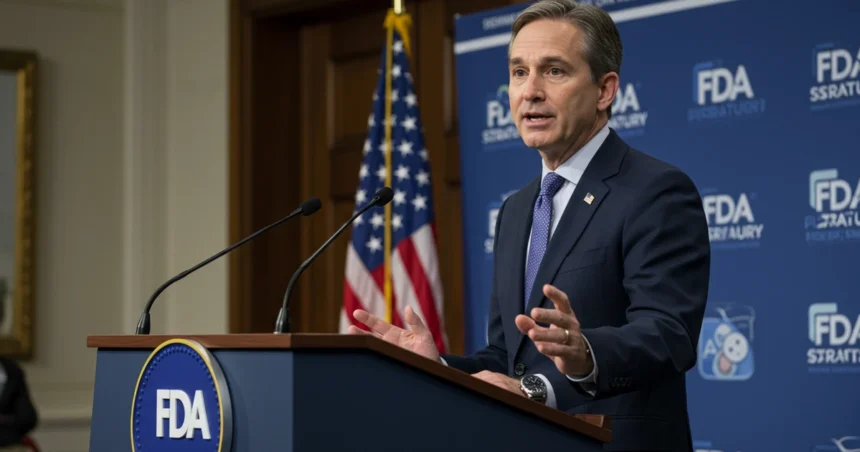
In a landmark announcement today, federal regulators released the much-anticipated fda infant formula safety results, confirming that the U.S. supply is overwhelmingly safe. The findings stem from the largest testing initiative in the agency’s history, providing a data-driven verdict for millions of American families.
→ SCOTUS Guts Voting Rights Act: What It Means
The extensive investigation, dubbed Operation Stork Speed, was launched to restore public confidence and provide transparency regarding chemical contaminants following previous market-wide concerns. Our team has analyzed the report to bring you the critical details. The latest fda infant formula safety results are based on rigorous testing of over 300 samples across 16 major brands.
→ Jacksonville Jaguars Vs 49ers Match Player Stats
A Landmark Investigation: What ‘Operation Stork Speed’ Found
The Food and Drug Administration (FDA) generated over 120,000 data points by analyzing formula powders, ready-to-feed liquids, and concentrates. Scientists screened for a wide range of substances, including heavy metals (lead, arsenic, cadmium, mercury), pesticides, PFAS, and phthalates.
The agency reported that an “overwhelming majority” of all products tested had undetectable or very low levels of these contaminants. For example, mercury was not detected in 95% of samples, while pesticides were absent in 99% of them.
Contaminant Findings at a Glance
The report provides specific data on heavy metal concentrations, which our team has summarized below. The levels are well below the U.S. Environmental Protection Agency (EPA) limits for drinking water.
| Contaminant | Detection Rate & Levels |
|---|---|
| Lead | Not detected in 20% of samples. 95% of all samples contained less than 0.5 parts per billion (ppb). |
| Arsenic | Not detected in 6% of samples. 95% of all samples had less than 2.0 ppb. |
| Cadmium | Not detected in 34% of samples. The median concentration was a low 0.2 ppb. |
| Mercury | Not detected in 95% of samples. All samples were at least six times below EPA drinking water standards. |
Understanding the FDA Infant Formula Safety Results
While the data is largely reassuring, officials stress the goal is continuous improvement. “We will hold manufacturers accountable, and give parents honest, transparent data they can trust,” said Health and Human Services Secretary Robert F. Kennedy, Jr. in a statement. This sentiment reflects the agency’s ongoing “Closer to Zero” initiative, which aims to reduce contaminants in foods for young children to the lowest possible levels.
The release of these fda infant formula safety results provides a crucial data point for parents and pediatricians. It stands in contrast to the 2022 crisis, which involved bacterial (Cronobacter) contamination and led to widespread recalls and shortages. Today’s report focuses specifically on environmental and chemical contaminants, an area of growing concern for consumers, as seen in discussions on platforms like Reddit.
This is a positive development, but it does not mark the end of regulatory oversight. The FDA has confirmed it will continue rigorous monitoring and follow-up testing, reinforcing that these fda infant formula safety results are a snapshot in an ongoing process. The agency’s full report can be found on the official FDA website.
Expert Q&A
Does this mean all formulas are 100% free of contaminants?
Not exactly. The report shows that while most formulas are safe, trace amounts of some contaminants were detected at very low levels. This is because these elements can be naturally present in the soil and water where ingredients are grown, as explained by the FDA. The key finding from the fda infant formula safety results is that these levels are low and the supply is considered safe.
What should I do with this information as a parent?
You can feel confident in the general safety of the U.S. infant formula supply, according to federal regulators. For parents seeking to minimize exposure, the FDA’s Closer to Zero program provides resources. The release of the fda infant formula safety results is intended to empower parents with transparent data.
Key Takeaways
- Supply is Safe: The FDA’s largest-ever study concluded the U.S. infant formula supply is safe, with an “overwhelming majority” of samples showing undetectable or very low contaminant levels.
- Specifics Matter: Testing for heavy metals, PFAS, and pesticides found levels well below federal limits where detected. The detailed fda infant formula safety results offer transparency for consumers.
- Ongoing Oversight: Regulators have committed to continued monitoring and working with manufacturers to drive contaminant levels even lower as part of the “Closer to Zero” initiative.
Relevant posts
- Seth Rogen’s New Show: A Hollywood Satire Success
- Pittsburgh Steelers Vs Chicago Bears Match Player Stats
- The Real News Kansas City Chiefs Dale Carter Retirement is Trending Right Now
Visit atholtonnews.com for more stories.