



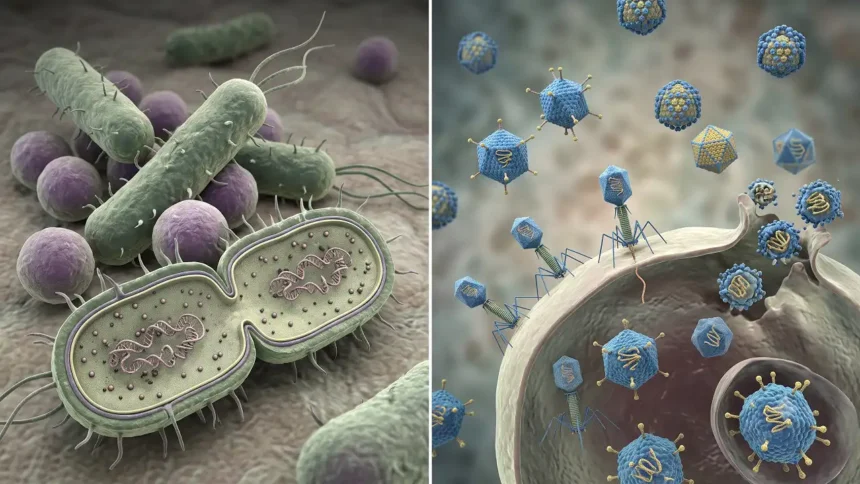
Students hit the apex biology unit and freeze on one question: how are viruses different from bacteria apex exams keep asking. The confusion is not random. Both cause illness, both spread fast, and both dominate headlines this flu-heavy summer of 2026. But they are not the same thing.
Bottom Line
- Bacteria are living cells. Viruses are not fully alive without a host.
- Antibiotics treat bacterial infections. They do nothing against viruses.
- Rising antibiotic resistance makes knowing the difference more urgent than ever.
What Is the Core Difference?
Our analysis suggests the fastest way to lock this in is a side-by-side view. This is the microbiology comparison most textbooks bury in paragraphs.
| Feature | Bacteria | Viruses |
|---|---|---|
| Living status | Living cell | Not fully alive |
| Size | 1,000–2,000 nm | 20–400 nm |
| Germ cell structure | Has a cell wall, cytoplasm | Protein coat, no cell |
| Reproduction | Divides on its own | Needs a host cell |
| Treatment | Antibiotics | Antivirals, rest |
The size gap alone is huge. A bacterium can be 100 times larger than a virus.
Kao USA Recalls Oribe Shampoo Over Bacterial Contamination Concerns
Why Does Treatment Split Them Apart?
Here is where students lose points. Antibiotics target living cell processes. Viruses have no cell to attack.
- Bacterial infection: treated with antibiotics.
- Viral infection: managed with antivirals, fluids, and time.
- Mixing these up fuels antibiotic resistance.
This is not a small detail. Prescribing antibiotics for a virus does nothing and makes future bacteria harder to kill.
How Does the Body Respond?
The immune response works against both, but the timing differs. Industry insiders are noting that this section trips up test-takers most.
| Stage | Bacteria | Viruses |
|---|---|---|
| Entry | Skin, food, wounds | Airborne, contact |
| Target | Tissue, bloodstream | Inside host cells |
| Immune response | White blood cells attack | Antibodies + T-cells |
| Recovery | Antibiotics speed it | Body clears it |
Your body treats them as separate threats. That is the reason the same treatment cannot cover both.
Walmart, Kroger, and Target Hit by Wave of Food Recalls Over Salmonella Fears
What Are the Main Pathogen Types?
If you have been following the apex biology track, this list won’t surprise you. These are the pathogen types the unit expects you to name.
- Bacteria: strep, E. coli, tuberculosis.
- Viruses: flu, COVID-19, measles.
- Fungi and parasites fall outside this comparison.
Only the first two matter for the classic viral vs bacterial infection question.
Which One Is Harder to Treat in 2026?
Both carry risk, but for different reasons. Here is the honest breakdown.
Bacteria pros and cons:
- Pro: Antibiotics usually work fast.
- Con: Antibiotic resistance is climbing sharply.
Viruses pros and cons:
- Pro: Vaccines prevent many strains.
- Con: Few direct cures exist once infected.
Neither is simply “worse.” Each demands a specific approach to infectious disease treatment.
Paul Pelosi Faces Hit-and-Run Charge After Napa County Crash
What Does This Mean for Students Right Now?
The exam rewards clarity, not memorized fluff. Focus on the split between living and non-living, and the treatment gap follows.
| Study Focus | Why It Matters |
|---|---|
| Cell vs no cell | Explains most exam answers |
| Treatment logic | Separates the two clearly |
| Germ cell structure | Common diagram question |
Master these three and the rest clicks.
The Bottom Line
Viruses and bacteria look similar on a headline but behave nothing alike. One is a living cell you can attack with antibiotics. The other hijacks your cells and waits out your immune response. That distinction is the whole answer. For anyone facing the microbiology comparison section this term, that single idea carries most of the points.
For More Latest Updates Atholton News