



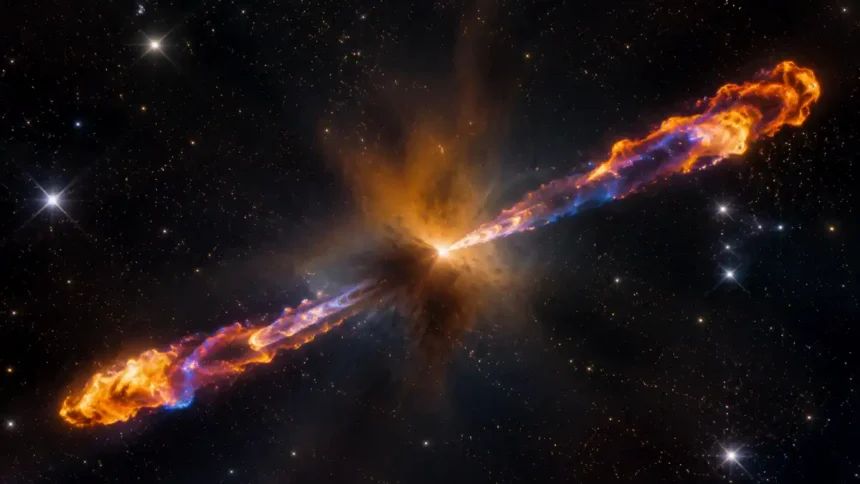
The James Webb Space Telescope just marked four years of science operations, and its archive of protostar jets has quietly rewritten the textbook on newborn stars. Webb’s best images show a Herbig-Haro and how they are photographed, which explains why astronomers now spot details that ground-based telescopes missed for decades.
Key Takeaways
- Webb’s NIRCam has imaged HH 46/47, HH 211, and HH 797, revealing structure that visible-light cameras could not capture.
- Infrared imaging cuts through thick dust, exposing the bow shock fronts and stellar outflows of hidden protostars.
- The HH 797 image proved its “twisted” jet comes from a binary star, not one rapidly spinning star.
What Is a Herbig-Haro Object?
A Herbig-Haro (HH) object is a glowing patch of gas lit by shock waves. A protostar (a star still gathering mass) fires jets from its poles. Those jets slam into surrounding gas at tremendous speed and make it shine. The objects carry the names of George Herbig and Guillermo Haro, who studied them in the 1940s and 1950s.
| Feature | What It Means |
|---|---|
| Jet | Narrow stream of gas from the star’s poles |
| Bow shock | Curved shock front where the jet hits gas |
| Outflow cavity | Hollow carved out by the jet |
| Knots | Bright clumps marking repeated outbursts |
Which Herbig-Haro Objects Has Webb Captured?
Webb has delivered three headline HH releases since 2023. Each one added a new layer to our understanding of star formation. Here is how they compare.
| Object | Release | Location | Key Finding |
|---|---|---|---|
| HH 46/47 | July 2023 | Vela, ~1,470 light-years | Twin lobes of a jet pair, rich background galaxies |
| HH 211 | September 2023 | Perseus, ~1,000 light-years | Jets up to 60 miles per second |
| HH 797 | November 2023 | Near IC 348, Perseus | Two parallel outflows from a binary source |
Why Did HH 797 Surprise Astronomers?
Ground-based telescopes showed HH 797 with an apparent twist. Researchers suspected a rapidly spinning star. Webb’s sharper view settled it: the “twist” is really two nearly parallel jets, each from its own star in a binary system. Industry insiders are noting that this kind of correction only happens when resolution improves.
How Are Herbig-Haro Objects Photographed?
Infrared light makes these images possible. Visible light gets blocked by dust, but infrared imaging passes through it. Webb’s Near-InfraRed Camera (NIRCam) also picks up glowing molecular hydrogen and carbon monoxide excited by the shocks.
| Telescope / Instrument | Wavelength | Strength for HH Work |
|---|---|---|
| Webb NIRCam | Near-infrared | Sharpest view of shocked hydrogen |
| Webb MIRI | Mid-infrared | Reveals cooler dust and deeply buried sources |
| Hubble WFC3 | Visible and near-infrared | Decades of motion tracking |
| ALMA | Radio (millimeter) | Maps cold gas and disks around protostars |
The Imaging Process, Step by Step
- Select a target inside a known star-forming cloud, such as Perseus.
- Choose filters tuned to molecular hydrogen and iron emission lines.
- Capture multiple exposures with NIRCam to build signal.
- Combine and calibrate the frames to remove detector noise.
- Assign colors to each filter so different gases stand out.
- Compare with older Hubble data to measure how fast the knots move.
What Does HH 211 Tell Us About the Young Sun?
HH 211 is an infant analogue of our Sun. Its central star is only a few tens of thousands of years old. It holds just 8% of the Sun’s mass and will keep growing.
| Metric | HH 211 Protostar | Our Sun |
|---|---|---|
| Age | ~Tens of thousands of years | 4.6 billion years |
| Mass | 8% of the Sun | 100% |
| Jet speed | Up to 60 miles per second | No active jets |
Our analysis suggests HH 211 is the clearest snapshot yet of what our own star looked like at birth.
Why Dr. Alexandra Estrella is Redefining Education in 2026
What Does This Mean for Astrophotography Fans?
If you’ve been following astrophotography, this won’t come as a surprise. Backyard imagers can capture bright HH objects, but only with patience and the right gear.
- Use a telescope with at least an 8-inch aperture.
- Add a hydrogen-alpha (Hα) filter to isolate shock-lit gas.
- Stack 10+ hours of exposures to bring out faint knots.
- Target HH 1/2 in Orion, one of the most photographed examples.
| Approach | Pros | Cons |
|---|---|---|
| Backyard Hα imaging | Affordable, personal | Visible light only, low detail |
| Public Webb archive | Free, research-grade data | Requires processing skills |
What Comes Next for Webb and Star Formation?
Webb’s fifth year of operations is underway. Astronomers plan more time-lapse comparisons to track how jets evolve. Pairing Webb, Hubble, and ALMA data gives the fullest picture of stellar outflows to date.
Your next step: open the MAST archive at the Space Telescope Science Institute and download the raw NIRCam frames of HH 211 to process them yourself.