



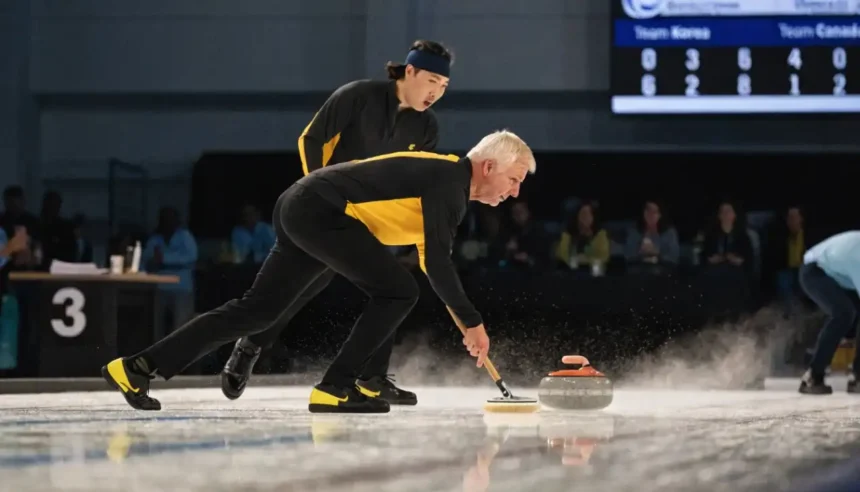
Every gold medal in curling comes down to a few centimeters and two people with brooms. So how do brushes affect the stone’s path in olympic curling?
They change the stone-ice friction underneath the rock, letting a team steer a 42-pound stone after it leaves the hand.
We dug into the science and the new rules to show you exactly what that means.
Key Takeaways
- Sweeping heats the ice, lowers friction, and can push a stone farther or hold its curling trajectory straighter.
- The World Curling Federation banned deceleration-focused strokes in its 2026 Sweeping Technique Policy.
- Male elite curlers apply about 632N of vertical load force; female curlers apply about 407N.
Check Also: Alysa Liu Wins the 2026 Olympics Women’s Free Skate
What Does Sweeping Actually Do to the Stone?
Sweeping does not touch the stone. It works on the ice ahead of it. The brush head speed and downward pressure raise the ice surface temperature, creating a thin water film that cuts drag.
Our analysis suggests this is the only moment in sport where you can steer a projectile after release.
| Sweeping Effect | What Happens on the Ice | Result for the Stone |
|---|---|---|
| Raises ice temperature | Thin water film forms | Less friction |
| Reduces friction | Stone slides easier | Travels farther |
| Directional sweeping | Corrects friction asymmetry | Holds line or curls more |
| No sweeping | Ice stays cold, full drag | Shorter, more curl |
The science behind this is detailed in a peer-reviewed sweeping study and a sports science review in JSSM.
What Changed in the 2026 WCF Rules?
The World Curling Federation published a new Sweeping Technique Policy in January 2026.
The goal is simple: allow sweeping that helps a stone, ban sweeping meant to slow it down.
| 2026 Policy | Permitted Techniques | Prohibited Techniques |
|---|---|---|
| Purpose | Make stone go farther | Increase deceleration |
| Purpose | Hold a stone straighter | Slow the stone on purpose |
| Stroke type | Standard back-and-forth brushing | Push-only single strokes |
| Brush handling | Finish to either side of stone | Keeping brush on ice while returning |
| Enforcement | Legal under Rule R8 | Stone removed after official warning |
Umpires now watch sweeping technique directly. If they spot a violation, the delivered stone can be pulled from play after a warning.
How Much Force Do Curlers Really Apply?
The numbers explain why coaches obsess over strength and speed. We found a clear split between how much vertical load force male and female curlers generate.
| Metric | Male Elite Curlers | Female Elite Curlers |
|---|---|---|
| Average vertical load | ~632N | ~407N |
| Sweep frequency | 4.32 strokes/sec | 3.81 strokes/sec |
| Fatigue over bouts | Larger drop-off | More consistent |
More force means more heat. More heat means less friction and a longer slide.
Does Sweep Direction Change the Distance?
Yes, and the gap is measurable. Sweeping along the stone’s line of travel outperformed sweeping across it in controlled testing.
| Sweeping Direction | Average Stone Distance |
|---|---|
| Along the axis of motion | 78.7 cm |
| Perpendicular to the axis | 59.0 cm |
Our analysis suggests the direction of the brush matters almost as much as the muscle behind it.
What This Means for Fans Watching in 2026
If you have been following curling, this shift will not surprise you.
Here is what to watch for during the next major event:
- Cleaner strokes, since push-only braking is now illegal.
- Sharper draws, as teams use direction to control the curling trajectory.
- Louder skips, calling sweep intensity based on stone speed and line.
The broom stays the quiet star of the sheet.
It cannot touch the stone, yet it decides where the stone stops.