



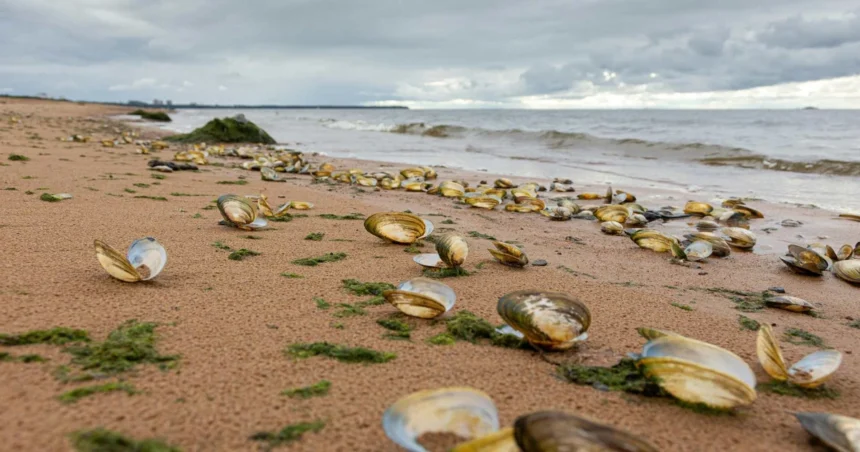
Manila Clam Spreading Atlantic Coastline: The Manila Clam Has Reached the Atlantic — and Scientists Have Complicated Feelings About It
→ Three Boaters Dead After Pontoon Collides with Commercial Barge on Lake Pepin
For years, the northeastern United States coastline held a rare distinction: it was the last stretch of the Northern Hemisphere where Manila clams had never taken hold. That distinction is now gone.
→ What Waymo Knows About You While You Ride — And What It Can Do With That Information
A team of biologists led by researchers at the University of Massachusetts Amherst, MIT Sea Grant, and the Center for Coastal Studies has confirmed that the Manila clam, *Ruditapes philippinarum*, has established itself along the northwestern Atlantic coastline. The findings were published in the journal *Biological Invasions* and announced in July 2026.
How it started with “weird clams”
The trail began in 2023 with reports of unusual clams spotted around Provincetown on Cape Cod. The sightings were curious enough to raise eyebrows among local observers, but confirmation took time. A text message in 2025 reignited the investigation, ultimately leading to the two-pronged research effort that produced this week’s announcement.
Cape Cod and the Boston area are now confirmed home territory for a species that originated in a range stretching from Russia’s Sakhalin Islands through Japan and into southern China. Manila clams spread across much of the world both accidentally, through ballast water and shellfish aquaculture transfers, and intentionally, as the species was deliberately farmed in new regions because of its commercial value.
A $7 billion clam with an asterisk
Here is where the story gets genuinely complicated. The Manila clam is not some obscure nuisance organism. It is one of the most commercially valuable shellfish on the planet, underpinning a global industry worth roughly $7 billion. Chefs prize it. Seafood markets move enormous quantities of it. In many parts of the world, it is farmed intentionally and eaten enthusiastically.
The researchers were careful to note that the clam’s arrival is not straightforwardly bad news. It is, by most accounts, delicious, and its presence could eventually open aquaculture opportunities in the region. But ecological history offers plenty of cautionary examples of commercially valuable species causing serious disruption once they move outside their native range.
What the arrival actually means for the ecosystem
The concern is not that Manila clams are toxic or immediately destructive. It is that any species establishing itself in a new environment where it has no natural predators or competitors can shift the balance of local ecosystems in ways that are difficult to predict and harder to reverse. Native clam species, existing filter-feeding communities, and the broader coastal food web could all feel pressure as the population grows.
The northeastern Atlantic had, until now, escaped this particular pressure entirely. Researchers had been watching other parts of the Northern Hemisphere absorb Manila clam populations for decades. The question was always when, not if, the species would eventually reach these shores.
Now that it has, scientists will be watching closely to see how quickly the population expands and what, if anything, changes in the communities around it.
What comes next
There is no immediate call for eradication, and given the species’ commercial profile, any management response will need to weigh ecological concerns against potential economic opportunity. Aquaculture regulators, marine ecologists, and state fisheries agencies along the Northeast coast will likely be pulled into those conversations as the research develops.
For now, the confirmed presence of Manila clams in Cape Cod and Boston-area waters marks a genuine turning point for the region’s coastal ecology. Whether that turns out to be a crisis, an opportunity, or something more ambiguous in between will depend on what the population does next and how quickly the science can keep pace with it.
Relevant posts
- Wyatt Russell Is Living Proof That the Apple Doesn’t Fall Far From the Tree
- The Costa Concordia Disaster: The Modern-Day Shipwreck That Killed 32 People and Shocked the World
- LeConte Lodge’s Iconic Recreation Building Is Coming Down After 50 Years on the Mountain
Visit atholtonnews.com for more stories.