



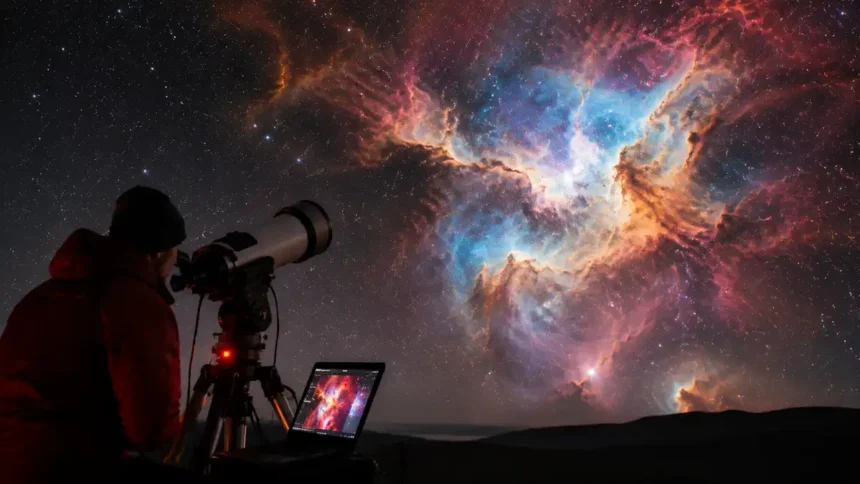
Four years after its debut, one image still sets the bar for space photography. To show the Carina Nebula and how it’s photographed, start with the James Webb Space Telescope‘s Cosmic Cliffs. That single frame turned hidden star birth into visible science, and it still shapes how every new nebula image is judged.
Key Takeaways
- Webb captured NGC 3324, the Cosmic Cliffs, about 7,600 light-years from Earth.
- NIRCam used infrared photography to reveal hundreds of previously hidden stars.
- The full image measures 14,575 × 11,227 pixels, credited to NASA, ESA, CSA, and STScI.
Why Is This Image Back in the News?
The Cosmic Cliffs remain the reference image for nebula photography. NASA released it on July 12, 2022, as part of Webb’s first science images. This month marks its fourth anniversary, and educators, astrophotographers, and researchers still use it as the standard. Industry insiders are noting that newer releases are routinely compared against it for detail and depth. Check the official STScI release page to download the full-resolution file.
Show the Carina Nebula and How It’s Photographed
What Exactly Is the Carina Nebula?
The Carina Nebula is a giant star-forming region in the southern sky. It is one of the brightest nebulae visible from Earth.
| Fast Fact | Detail |
|---|---|
| Catalog name | NGC 3372 |
| Featured region | NGC 3324 (Cosmic Cliffs) |
| Distance | About 7,600 light-years |
| Constellation | Carina |
| Best viewing | Southern Hemisphere |
| Famous resident | Eta Carinae, an unstable supergiant |
| Also contains | The Keyhole Nebula |
| NGC 3324 first cataloged | 1826, by James Dunlop |
Show the Carina Nebula and How It’s Photographed
How Did Webb Photograph the Cosmic Cliffs?
Webb photographed the Cosmic Cliffs in infrared light. Dust blocks visible light, but infrared passes through it. Here is the process, step by step:
- Collect light with Webb’s 6.5-meter gold-coated mirror.
- Capture infrared wavelengths through NIRCam (Near-Infrared Camera).
- Filter the light into separate bands, one exposure per filter.
- Assign visible colors to each infrared band.
- Combine the layers into one composite image.
The final result is a translation, not a snapshot. Which is why every color has a scientific meaning.
Why the Show the Carina Nebula and How It’s Photographed in 2026
Which Filters Created Those Colors?
Each NIRCam filter isolates one slice of infrared light. Image processors then map each slice to a visible color.
| NIRCam Filter | Assigned Color | What It Highlights |
|---|---|---|
| F090W | Blue | Shorter infrared, starlight |
| F187N | Cyan | Hydrogen emission |
| F200W | Green | Stars and dust edges |
| F335M | Yellow | Hydrocarbon-rich dust |
| F444W | Orange | Warm dust, hidden stars |
| F470N | Red | Molecular hydrogen, jets |
Shorter wavelengths get bluer colors. Longer wavelengths get redder ones.
How Does Webb Compare With Hubble?
Webb sees through dust, while Hubble sees the dust itself. Both telescopes have photographed Carina, with very different results.
| Feature | Hubble | James Webb Space Telescope |
|---|---|---|
| Launch | 1990 | December 25, 2021 |
| Mirror size | 2.4 meters | 6.5 meters |
| Main light | Visible, ultraviolet | Infrared |
| Location | Earth orbit | Sun-Earth L2, ~1.5 million km |
| Carina strength | Glowing gas, dust walls | Hidden stars, jets |
| Key Carina image | Mystic Mountain (2010) | Cosmic Cliffs (2022) |
Our analysis suggests the two views work best side by side.
What Did the Image Actually Reveal?
The Cosmic Cliffs image revealed early star formation in action. That stage lasts only 50,000 to 100,000 years per star, making it rare to catch.
- Rising “steam”: hot, ionized gas streaming off the nebula
- Towering pillars: dust resisting ultraviolet radiation
- Bubbles and cavities: blown open by newborn stars
- Gold jets: protostellar outflows from nascent stars
- Background galaxies: visible through the nebula
The field of view spans roughly 16 light-years.
How Has Carina Photography Evolved?
Carina photography has moved from visible light to deep infrared. Each milestone added new layers of detail.
| Year | Milestone |
|---|---|
| 1826 | James Dunlop catalogs NGC 3324 |
| 1840s | Eta Carinae‘s Great Eruption brightens the region |
| 2007 | Hubble releases a wide Carina mosaic |
| 2010 | Hubble’s Mystic Mountain anniversary image |
| 2022 | Webb releases the Cosmic Cliffs |
| 2026 | Cosmic Cliffs marks its fourth anniversary |
If you’ve been following astronomy, this steady climb won’t come as a surprise.
What Does This Mean for Readers and Astrophotographers?
The Cosmic Cliffs image is free to use. Webb material is public domain when NASA and STScI are credited.
- Download the full 122 MB file from STScI
- Credit NASA, ESA, CSA, and STScI
- Compare it with Hubble’s Mystic Mountain
- Study the color key to learn filter mapping
Your next step: open the NIRCam compass image and match each color to its filter.
RECENT POST
Show a Herbig-Haro and How They Are Photographed
Show the Carina Nebula and How It’s Photographed
Troy Aikman Lawrence McCutcheon Tribute Honors a Rams Icon
Carlsbad Caverns Cheetos Impact: One Bag, Big Damage