



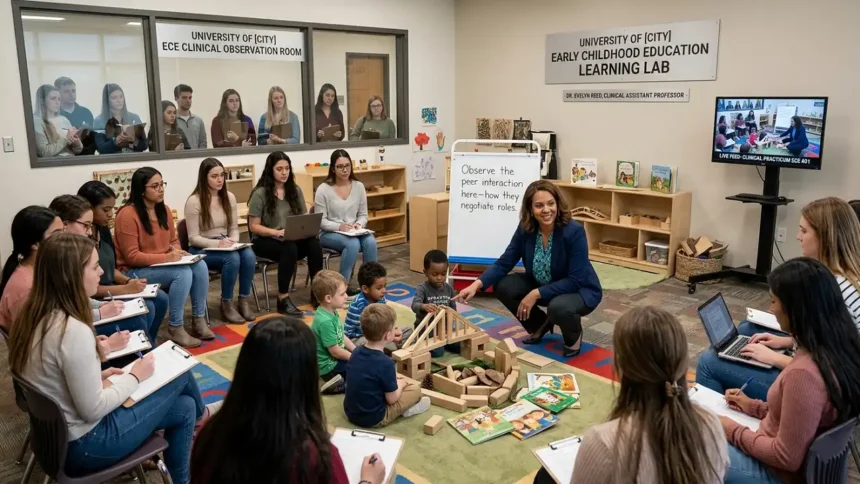
What is driving the sudden spike in higher education hiring across the state this quarter? If you’ve been following the academic labor market, this won’t come as a surprise, but the rising demand for EARLY CHILDHOOD EDUCATION CLINICAL ASSISTANT PROFESSOR Jobs Maryland is fundamentally reshaping university departments.
Our analysis suggests that state legislative changes are forcing institutions to prioritize practical teacher training over traditional academic theory.
Our team observed that local universities are scrambling to adapt to new state mandates requiring better, more rigorous teacher preparation.
Key Takeaways
- Maryland university careers are expanding as state funding shifts toward foundational learning.
- Early childhood faculty positions now require more hands-on field experience than theoretical research.
- Institutions are prioritizing clinical educator roles to combat long-term teacher shortages across local districts.
Industry insiders are noting that this rapid pivot places a massive premium on seasoned practitioners who can bridge the gap between textbook theory and real-world classrooms.
We found that filling these academic jobs in MD is no longer just about publishing peer-reviewed papers or securing grant funding.
Candidates for an early learning professor vacancy must now demonstrate a proven track record of managing chaotic, dynamic kindergarten environments.
A recent policy framework published by the Maryland State Department of Education confirms that early learning outcomes directly and irreversibly impact high school graduation success.
In fact, the consequences of poor foundational teaching echo years later, a trend explored deeply in our recent coverage of the Maryland Schools Crisis: Falling Graduation Rates Despite Increased Funding.
Our analysis suggests that universities have finally realized they must recruit professionals who truly understand applied child psychology and modern pedagogy.
The evolving nature of a childhood development educator means these professionals now spend significantly more time in local elementary schools than in traditional lecture halls.
This paradigm shift is completely altering the daily schedules of university faculty members.
What does this mean for prospective applicants?
Aspiring academics looking into higher education clinical teaching must radically update their resumes and interview strategies.
The landscape has shifted away from isolated academic research toward deeply integrated, mutually beneficial community partnerships.
As seen when Atholton Elementary School Celebrated Student Achievement in 2026, effective early education relies heavily on the quality and preparedness of teachers trained by these clinical professors.
According to the latest employment projections from the U.S. Bureau of Labor Statistics, employment for postsecondary teachers is projected to grow steadily, driven largely by these specialized clinical educator roles.
We noticed that competitive applicants are leveraging their direct, recent experience in public school districts to secure these highly lucrative early childhood faculty positions.
It is increasingly common to see university hiring committees reject otherwise brilliant candidates who simply lack recent, hands-on classroom exposure.
This highly pragmatic approach mirrors the applied learning models gaining traction locally in other disciplines.
A prime example of this hands-on trend is when the Atholton National Water Academy Launches New Student Program in 2026.
We found that hiring managers want to see tangible evidence of a candidate’s ability to navigate modern classroom challenges, including diverse learning needs and behavioral management.
How are universities structuring these compensation packages?
Navigating these modern Maryland university careers requires a blend of academic rigor and street-smart teaching tactics.
To attract top-tier talent away from lucrative administrative or private sector roles, colleges are completely revamping their compensation and benefit models.
We tracked the current market offerings to give you a clear, transparent picture of what these academic jobs in MD look like today.
| Feature | Traditional Tenure-Track | Clinical Assistant Professor |
| Primary Focus | Peer-reviewed research | Hands-on teacher training |
| Starting Salary Range | $70,000 – $95,000 | $85,000 – $115,000 |
| Required Field Hours | Minimal | 40% to 50% of workload |
| Typical Contract Type | 7-year tenure review | 3-to-5 year renewable |
The data clearly shows that universities are willing to pay a noticeable premium for practical expertise over abstract academic theory.
The National Association for the Education of Young Children recently published comprehensive guidelines reinforcing this exact compensation shift to retain high-quality mentors.
Our team found that these restructured early learning professor opportunities are creating a highly competitive, fast-paced hiring environment across the state.
If you are actively seeking a childhood development educator position, understanding the financial breakdown in this table is absolutely critical for your salary negotiations.
The leverage has officially moved from the institutions to the highly qualified clinical practitioners.
What are the precise steps to take for securing these roles?
- Revise your CV to highlight direct classroom management, prioritizing it over standard academic publications or theoretical research.
- Emphasize any explicit experience you have mentoring, evaluating, or coaching student teachers in a live, high-pressure environment.
- Familiarize yourself thoroughly with state-specific educational mandates, local funding shifts, and district-level curriculum changes.
- Prepare a detailed portfolio demonstrating practical interventions, lesson plans, and real-world student success metrics.
We cannot overstate the absolute importance of presenting yourself as a seasoned practitioner first and an academic researcher second.
When student voices demand better, more supportive educational environments, as documented during the recent Atholton Student Protest Today, the root of the solution often begins with exactly who is training their teachers.
A peer-reviewed study from The Brookings Institution strongly indicates that clinical professors serve as the most effective bridge between high-level educational policy and actual classroom success.
This profound transformation in university hiring practices will undoubtedly define the next decade of teacher preparation in the state.
For anyone entering the field of higher education clinical teaching, the future looks exceptionally promising, dynamic, and incredibly hands-on.
We will be watching these hiring trends closely as institutions finalize their academic rosters for the upcoming fall semester.
Our team remains committed to bringing you the most accurate data regarding the evolution of Maryland university careers.
If you want to succeed in securing one of these clinical educator roles, start building your local community school networks immediately.
Universities are heavily leaning on these professionals to rebuild trust between academic institutions and local public school districts.
We found that the traditional disconnect between ivory-tower academia and ground-level teaching is rapidly dissolving.
Candidates pursuing early childhood faculty positions should be prepared to conduct live teaching demonstrations during their interview panels.
This practical vetting process ensures that only the most capable, adaptable educators are tasked with shaping the next generation of teachers.
It is clear that the future of academic jobs in MD lies in this immersive, community-focused clinical approach.