



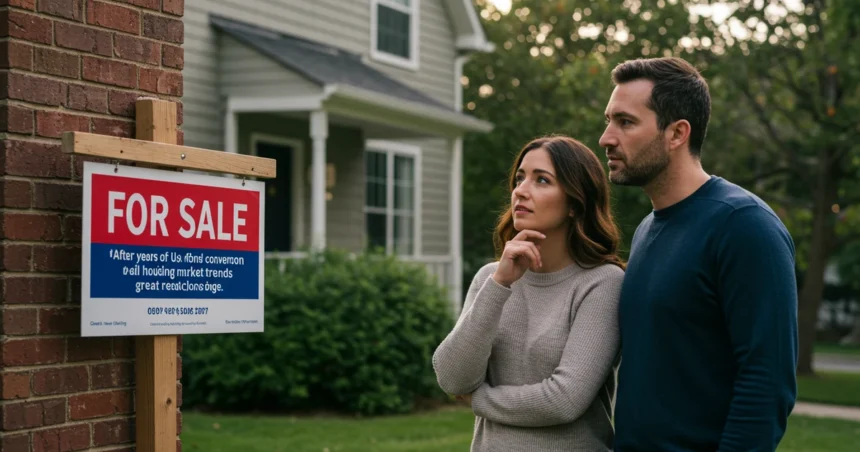
After years of volatility, the conversation around 2026 us housing market trends is shifting toward a “great rebalance.” Recent analyses from major real estate platforms and economists suggest a market defined by modestly increasing inventory, stabilizing prices, and the powerful influence of persistent, albeit slightly lower, mortgage rates. Buyers are finding more breathing room, but affordability remains a central challenge.
→ Aryna Sabalenka: Dominant Win Amidst Controversy
Our team’s analysis of recent forecasts indicates that the frenetic seller’s market of the pandemic has cooled, giving way to a more cautious and selective environment. While a market crash is not anticipated by most experts, the rapid price gains of previous years have decelerated sharply.
→ Maryland Job Search: A Tale of Two Economies
Key Forecasts: NAR vs. Zillow
Major housing authorities offer slightly different takes on the year ahead, but both point toward a market in transition. Our team compiled the core predictions from the National Association of Realtors (NAR) and Zillow to offer a clearer picture of what to expect.
| Metric | NAR Forecast | Zillow Forecast | Source |
|---|---|---|---|
| Existing Home Sales | ~14% increase | ~4.3% increase | |
| National Home Prices | ~2-4% increase | ~1.2% increase | |
| Mortgage Rate Outlook | Easing to ~6% | Holding above 6% | |
| Overall Sentiment | “Positive Recovery” | “Healthier State” |
For more discussion, see this discussion on Reddit.
Expert Q&A: Navigating the 2026 Market
We posed some of the most pressing questions to leading economic voices to distill the current sentiment.
Is 2026 a good time to buy a home?
Most experts agree that timing the market is nearly impossible. The consensus advice for prospective buyers is to focus on personal financial readiness. Orphe Divounguy, senior macroeconomist at Zillow Home Loans, states, “The best time for prospective buyers is when they find a home that they like, that meets their family’s current and foreseeable needs, and that they can afford.” The 2026 us housing market trends suggest that while buyers have more negotiating power, affordability remains the primary hurdle.
Will home prices drop in 2026?
A widespread drop in home prices appears unlikely. NAR’s Chief Economist, Lawrence Yun, has stated that “Home prices are in no danger of any major decline,” citing factors like wage growth and persistent, albeit modest, demand. Instead of a crash, the 2026 us housing market trends point to a significant slowdown in price growth, with some regional markets even seeing minor corrections while others hold steady. The key takeaway is a market stabilizing, not collapsing.
The Great Rebalancing Act
After several years of a market heavily favoring sellers, 2026 is emerging as a period of normalization. Zillow economists predict the market will become more balanced, benefiting both buyers and sellers in different ways. Sellers can expect more stable pricing and consistent demand, while buyers are seeing more choices and a slight easing of the intense bidding wars that defined recent years. This shift is a core component of the 2026 us housing market trends.
The “lock-in effect”—where homeowners are reluctant to sell and give up their ultra-low mortgage rates—is beginning to wane as life events prompt moves. This, combined with an uptick in new construction, is slowly adding to the for-sale inventory. According to a recent report from Redfin, this is all part of “The Great Housing Reset,” a multi-year period of gradual recovery.
Regional Divergence and Affordability
National averages only tell part of the story. A key theme within the 2026 us housing market trends is regional divergence. Markets in the Midwest, like Ohio, are showing resilience due to better affordability, while some Sunbelt markets in Florida and Texas are experiencing a more significant cooldown with softer pricing. This is a reversal from pandemic-era trends and highlights the growing importance of local economic stability.
Discussions on social media platforms like Reddit reflect this cautious sentiment, with many potential buyers weighing the high cost of borrowing against rising rents. One user’s analysis of Q1 data pointed out that while inventory is normalizing, the primary constraint remains purchasing power, which is directly impacted by mortgage rates hovering above 6%. This underscores the affordability crisis that continues to shape the 2026 us housing market trends.
Experts from the National Association of Realtors (NAR) project that a drop in mortgage rates to the 6% threshold could unlock millions of additional qualified homebuyers, suggesting a large amount of pent-up demand is waiting on the sidelines. However, Zillow’s forecast is slightly more conservative, predicting rates will hold above 6% for the remainder of the year. This difference in rate prediction is central to the varying outlooks on the speed of the market’s recovery. As the year progresses, all eyes will remain on the Federal Reserve and inflationary pressures that influence these critical borrowing costs. The 2026 us housing market trends will ultimately be dictated by this delicate balance.
Key Takeaways
- Modest Growth, Not a Crash: Expect home prices to rise modestly, around 1-4%, rather than decline nationally.
- Sales Volume Increasing: Both NAR and Zillow project an increase in the number of homes sold compared to 2025, signaling more activity.
- Affordability is Key: Mortgage rates holding above 6% remain the biggest hurdle for buyers, significantly impacting purchasing power.
Relevant posts
- Babysitting Job Near Me: Navigating the 2026 Sitter Boom
- Andrew Ross Sorkin: The AI Market Crash He Predicts
- Attorney General of Pennsylvania Appeals Abortion Ruling: What’s Next
Visit atholtonnews.com for more stories.