


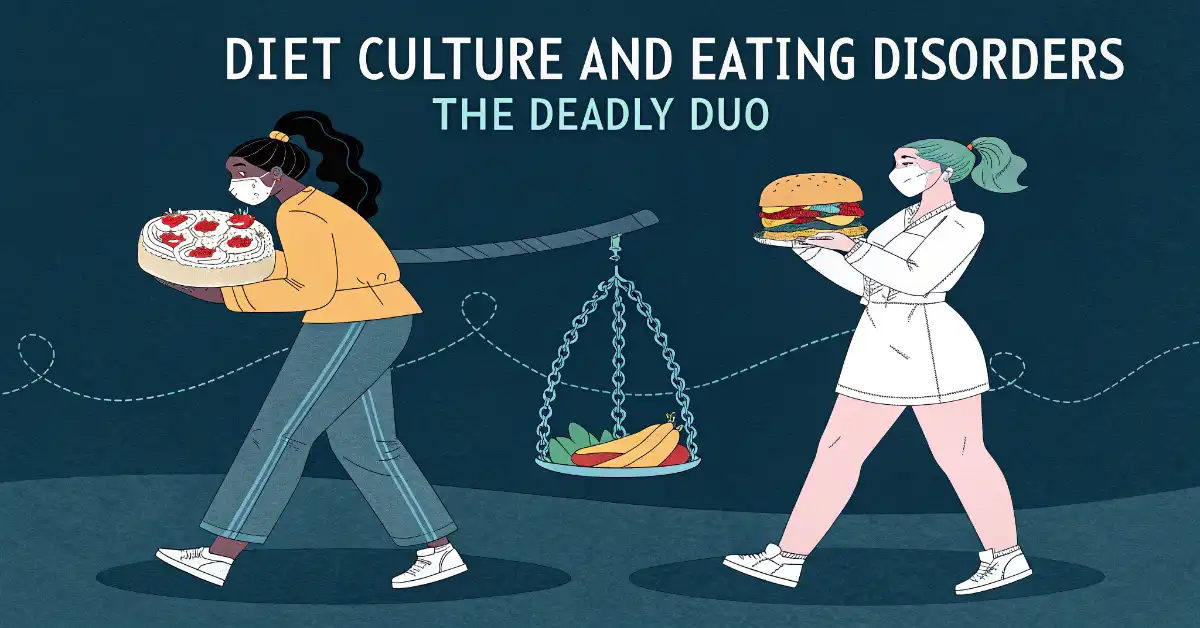
You scroll through social media and see yet another influencer promoting their diet that made them lose ten pounds in a week. You turn on the T.V. and see another commercial for diet pills. You talk to your friends and the only conversation topic is getting their summer bodies ready. You are a teenager and this is diet culture trying to get to you.
The term “diet culture” is thrown around in health and eating disorder recovery spaces , but what does it really mean? Behavioral Nutrition defined diet culture as “the glorification of losing weight at all costs.”
This glorification exists everywhere: from medical discrimination faced by plus-sized people, to the lack of clothing options for plus-sized bodies.
A blog post from Harvard Medical School wrote, “Weight bias is pervasive in medicine,” describes doctors that telling plus-sized patients to lose weight when a concern is addressed and the consequences that stem from this.
An article from BBC News described the clothing industry as “habitually excluded them [plus-sized people] to promote a thin and often unattainable ideal.” One of the consequences of the prevalence of diet culture is the development of disordered eating.
The terms “disordered eating” and “eating disorder” may sound similar, but they describe two different things. Disordered eating is an “unhealthy eating pattern that is more subtle in its behavioral manifestation than an Eating Disorder,” by the Disordered Eating Guardian. Disordered eating can spiral into a diagnosable eating disorder.
The dictionary definition of an eating disorder is “any of a range of mental conditions in which there is a persistent disturbance of eating behavior and impairment of physical or mental health”.
In simpler language, disordered eating is the middle ground between normal eating patterns and an eating disorder. Getting help when someone is exhibiting signs of disordered eating before they develop an eating disorder can save their life.
Diet culture and disordered eating go hand in hand. Diets that demand consumers cut out entire food groups are not promoting health; they’re promoting thinness. One of diet culture’s favorite punching bags is carbohydrates.
Carbs are necessary for brain and body function, yet many diets encourage cutting them out completely. According to an article from Harvard T.H. Chan, carbohydrates “provide the body with glucose, which is converted to energy used to support bodily functions and physical activity.”
The only thing cutting out carbs or any food group will accomplish is making consumers unhealthy. An article from the National Library of Medicine linked carbohydrate restriction that lasts for periods of months to years with “osteoporosis, kidney damage, increased cancer risk, impairment of physical activity and lipid abnormalities.”
Even if consumers avoid the health consequences of some of these diets, their relation ship with food will be damaged. Avoiding “unhealthy” foods, restricting, and monitoring weight easily transition to disordered eating.
Diets like intermittent fasting (an eating pattern where one cycles through periods of eating and fasting) that encourage ignoring the body’s hunger cues can become anorexia. Thirty day diets that make consumers binge after their restriction period can become binge eating disorder or bulimia.
“The best-known environmental contributor to the development of eating disorders is the sociocultural idealization of thinness.”
The National Eating Disorders Association claimed. There is no escape from the message that “thin equals attractive.” Affordable and cute clothing options for plus-sized people is a recent development.
Celebrities and models are still primarily thin. Finding a fat character that isn’t obsessed with food or plays second-fiddle to the thin main character is like playing Where’s Waldo. The obsession with size and weight starts young and only gets worse from there.
The National Eating Disorders Association claimed that girls start to express concerns about their weight at age six.
“40-60% of elementary school girls (ages 6-12) are concerned about their weight or about becoming too fat.”
These feelings easily transition to disordered eating and eating disorders later in life. Diet culture promotes using unhealthy means to achieve thinness, as shown by demonizing necessary foods and encouraging under-eating.
One of the main ways diet culture promotes it self is through media. Commercials, TV shows, and social media are the main perpetrators. The overrepresentation of thin people and the un least one food journal in a health class to pro mote healthier eating, but students agree that food journals may do more harm than good.
derrepresentation of plus or mid-sized people creates a feeling of isolation and a desire to be thin. Instead of trying to eat a nutritious diet, teenagers are concerned about their weight and body size.
It has never been about health; it has always been about being thin. Teenagers agree that the media plays a large role in their insecurities because there isn’t enough representation for bigger bodies. “It’s really bad if you don’t see yourself in those people in the media,” said Atholton freshman Sitara Canada.
School, the place where teenagers spend a lot of their time and make most of their friends, can be a contributing factor. Assignments like food journals are the main suspect. A food journal is writing down what a person ate over a period of time.
Most students have done at least one food journal in a health class to pro mote healthier eating, but students agree that food journals may do more harm than good.
Atholton sophomore Mari Bonilla, who was suffering from an eating disorder when the food journal was assigned, said “It just made me feel like I am harming myself so I might as well not eat at all. Or just not have food.”
While food journals do have good intentions, they can be detrimental for all teeangers, not just those who already struggle with disordered eating. “I started to feel self conscious about what I’ve eaten and how much I’ve eaten,” said Mendoza.
Students agree that more consideration needs to be put into assignments like food journals.
Despite how persuasive diet culture is, measures are being taken to try to fight back. Mid-sized and plus-sized models are becoming more and more popular. Eating disorders and warning signs are taught about in health classes across the country.
There are social media accounts dedicated to deconstructing diet culture. While all these actions are a step in the right direction, there is still a long, uphill battle against diet culture, especially for teenagers.
At the end of the day, diet culture is detrimental and toxic for teenagers. Nobody, especially not the most insecure age range, should equate a number on a scale with their health. Eating healthy is important, but that’s not what diet culture wants.
Diet culture promotes dis ordered eating and insecurity. Listening to real medical professionals instead of people trying to sell you a product is a great way to start. Lis ten to your body and make the choices that are right for you.