



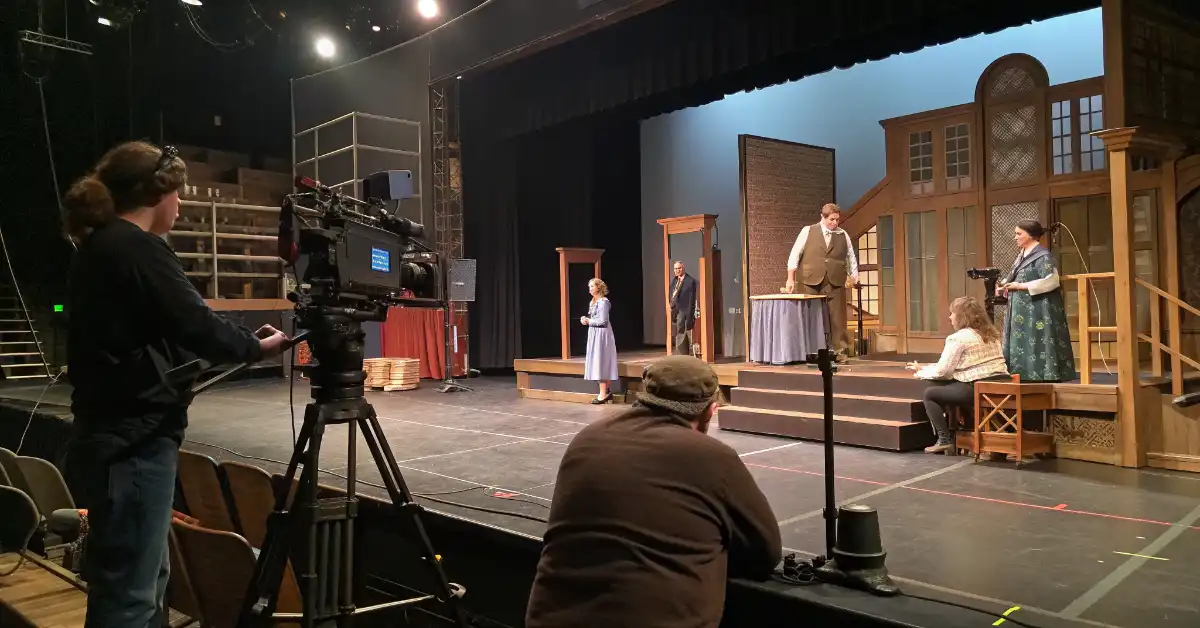
Performances work like a well oiled machine. All of its pieces are synchronized to create an authentic rhythm, making the perfect medium for storytelling.
This year’s Atholton School play production of Greek Mythology Olympiaganza was performed from November 21st to November 23rd. By that point every aspect of the performance routine had polished into its final form, but no performance ever started out that way.
“You don’t really see where it’s going when you’re preparing for the show,” said Hails Clapsadle, a cast member in Greek Mythology Olympiaganza.
“You’re like ‘okay here’s the scene I’m doing. Doesn’t seem like it fits; I don’t know how this is going to work,’ and then you get to the show and you’re like ‘Oh my God it’s so beautiful!”
There is a lot that goes into the behind the scenes of any play and plenty of aspects of the process are shrouded in mystery for the average audience member. Each play poses its own unique strengths and weaknesses, Greek Mythology Olympiaganza included, but even standard parts of the process have their own obscure aspects.
From how it is prepared for so quickly, to why a play is chosen, why a show may be edited, and even what the actual role of the theater teacher is, curiosities about how theater play production work are practically endless.
The mystery of how a play is chosen in the first place is a big one, one that not even everybody who performed the play may know the answer to. It started way, way back at the end of the last school year. Atholton High School’s theater teacher, Ms. Adler, chose which play they would perform.
“Honestly the most important thing to know when you’re choosing a theater play production is knowing your talent and knowing your pool of actors.”
She went on to say, “I think that is the trick with doing any play production anywhere, is what are you able to do amazingly with the limitations and with what you gave.”
Another big thing to keep in mind when she chooses a play is “being open to discovery”. So when she chanced upon Greek Mythology Olympiaganza, a play that was not exactly well known, and determined it would work well with her talent, she decided to give it a shot.
Atholton High School’s play production of Greek Mythology Olympiaganza only performed eleven out of the twelve scenes, as the decision was made to cut one.
All edits for an individual play production of a play have to abide by the instructions given by the rights holder of the play, which dictate how they are allowed to edit the script, and Greek Mythology Olympiaganza was no different.
Ms. Adler commented that there was a chapter depicting Pandora’s box that “we had to cut” for several reasons. First, the show was going to end up being too long without cuts, so one of them needed to go.
Pandora’s box was a scene that Ms. Adler determined did not need to be on the school stage since it had “…notions of women, you know, their place being in the house” and while those ideas would have been historically accurate to ancient Greece, it would not have been worth making the audience sit through it “and perpetuating that stereotype” to everybody watching.
It is no secret that theater only has a few short months to prepare for their performances. With so many jobs to do, including set building, costumes creation, lighting, and so much more, a few months is practically nothing. Tim Wright, the head stage manager of tech crew, explained that during that time everybody all worked on different things.
“People will be working on costumes, others will be working on the set, another group could be getting their technical equipment ready, and so on all at the same time.”
As Ms. Adler puts it, “… in the rehearsal process they work parallel, in tandem.” Everything came together during tech week, the week before the play in which all the cast and tech crew come together to set up the show which creates the show the audience gets to see.
Every member of theater collectively agreed on one thing, they wanted more people to join the theater department, from Clapsadle who commented that “It’s great! It’s fun! It’s amazing!”, to Wright who said “You all should join drama. You can be a techie, you can be an actor, but you should give us more people,” and even Ms. Adler requested that “…if the person reading this article is remotely interested in being a part of it, being a part of the play, being a part of tech, being a part of any aspect of this play production, take the leap, you know? Because there is a community of students who are wonderful, who are open minded, who are accepting… We’re here and we’re ready for you.”