



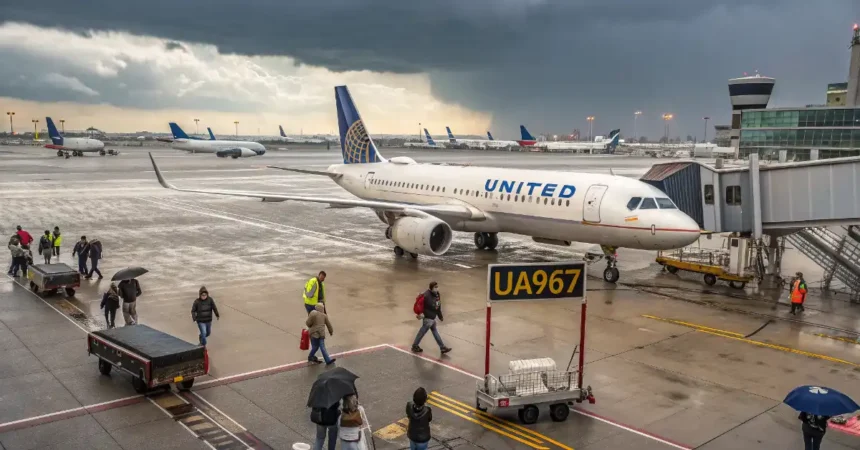
Air travel is a remarkable achievement of human engineering — connecting people across continents in hours instead of days or weeks. Yet, even in 2026, when technology has never been more advanced, flights sometimes face unexpected challenges. One such notable incident that drew significant attention from travelers and aviation enthusiasts alike was United Flight UA967 diverted from its planned route. In this in-depth article, we explore what happened, why the diversion occurred, and what it means for both passengers and the airline industry.
Introduction
On a late summer evening in August 2025, United Flight UA967 — scheduled from Naples, Italy to Newark, New Jersey (USA) — encountered an unexpected turn in its journey. Roughly halfway across the Atlantic Ocean, the flight crew detected an issue that prompted a critical decision: to divert the aircraft for safety reasons rather than push forward toward the destination. This incident was widely reported and later confirmed by United Airlines as a safety-first action rather than a routine delay — a topic that led to the keyword phrase United Flight UA967 Diverted trending across news and aviation forums.
Diversions like UA967 are rare, and they serve as high-profile examples of how airlines balance passenger comfort, schedule commitments, and — above all — safety. This article breaks down the event in clear, simple terms and explains the technical, procedural, and emotional sides of such a moment.
What Exactly Happened with United Flight UA967?
In aviation, the term diversion refers to a flight landing at an airport other than its scheduled destination due to an unforeseen circumstance. For United Flight UA967 diverted, the cause was not turbulence or a weather front later in the journey, as many might assume, but a technical alert in the aircraft’s system that suggested a potential safety concern.
Overview of the Flight
| Flight Detail | Information |
| Flight Number | UA967 |
| Departure Airport | Naples International Airport (NAP) |
| Scheduled Destination | Newark Liberty International Airport (EWR) |
| Aircraft Type | Boeing 767-300ER |
| Issue Encountered | Burning odor and system alert related to equipment fan |
| Diversion Airport | St. John’s International Airport (YYT), Newfoundland, Canada |
| Outcome | Safe landing with no injuries, passengers later continued to EWR on a replacement aircraft |
| Delay Duration | Approx. 10+ hours behind original schedule |
This table helps contextualize the key data around the diversion — showing how a seemingly routine long-haul flight became an unexpected detour.
Why Was United Flight UA967 Diverted?
Contrary to rumours and initial speculation online, the United Flight UA967 diverted was not solely due to adverse weather, but because of an alert triggered by the aircraft’s monitoring systems. These sensitive systems monitor numerous environmental and mechanical parameters in flight.
Atholton Elementary School Celebrates Student Achievement in 2026
Technical Alert Triggered Mid-Air
About seven hours into the flight, the cockpit crew noticed a burning odor and a corresponding alert linked to the aircraft’s forward equipment exhaust fan. Although passengers might not be familiar with this term, the main idea is this:
- The aircraft’s environmental control system includes a set of fans responsible for ventilation and temperature regulation.
- An alert linked to this system suggests a potential malfunction that, if ignored, might lead to more serious issues.
- Given that the aircraft was over the ocean with limited options for emergency landings farther ahead, the crew chose to divert to the nearest suitable airport — St. John’s, Newfoundland.
Safety First: Why Diversions Matter
Aviation does not take chances. When a system signals possible risk, pilots and dispatch teams are trained to act swiftly. In UA967’s case:
- The burning smell and alert were treated as precautionary.
- The pilots consulted airline operations and air traffic control.
- A descent toward an alternate landing option was initiated.
Even though no injuries occurred and the aircraft was structurally sound, landing sooner rather than later allowed maintenance crews to thoroughly investigate and fix the issue.
Where Did the Flight Land and What Happened Next?
After making a safe approach, United Flight UA967 diverted to St. John’s International Airport (code: YYT), a location well equipped to handle international diversions comfortably. This airport is often used by transatlantic flights for precisely these kinds of contingency situations.
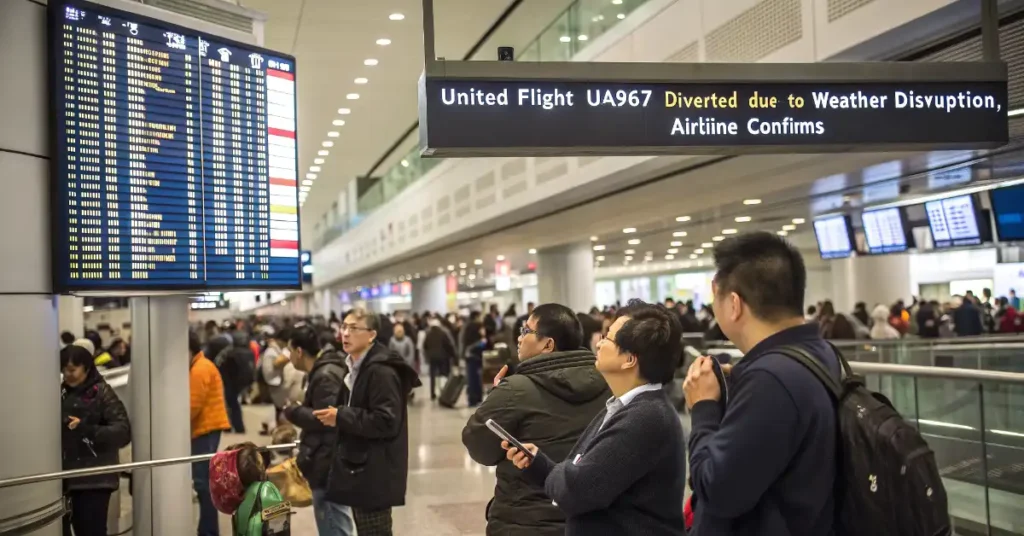
Once on the ground:
- Passengers disembarked normally.
- Airport rescue and firefighting teams were on standby, as is standard for diversions.
- United Airlines arranged a replacement Boeing 767 aircraft (tail number N673UA) to continue the journey.
- Passengers were accommodated as needed before the final leg to Newark — arriving more than 10 hours later than originally planned.
Passenger Experience and Airline Response
Diversions are usually stressful for passengers, and that was true for those aboard UA967 as well. While the airline emphasized that safety was never compromised, passengers experienced:
- An unexpected overnight stop in a city they hadn’t planned to visit.
- Missed connection flights for some.
- Delays in luggage delivery and final arrival at their homes or destinations.
United Airlines responded by offering assistance such as meal vouchers, accommodation support where necessary, and rebooking options. These steps are part of standard protocol when flights are diverted due to safety issues, and they reflect the company’s commitment to passenger care even in difficult situations.
Weather vs. Technical Issues: Understanding Rumours
Many people initially assumed that United Flight UA967 diverted because of bad weather — a common reason flights are rerouted. Indeed, severe weather (like thunderstorms, hurricanes, heavy winds, or low visibility) is a major cause of many diversions worldwide. However, official reports confirmed that this specific diversion was linked to aircraft systems and not directly to weather conditions.
This distinction is important because:
- Weather diversions usually involve atmospheric conditions that prevent safe landing at the destination.
- Technical diversions, like UA967, involve aircraft conditions that, while not immediately life-threatening, could escalate if ignored.
In this case, United Airlines’ careful handling ensured the flight landed safely without exacerbating any risk.
What the Aviation Community Says
Aviation experts and frequent flyers often use events like these as teaching moments. They point out that:
- Diversions are rare but built into everything airlines do.
- Systems in modern aircraft are designed to detect even very subtle anomalies.
- Crew training and redundancy systems mean that most diversions are precautionary rather than dire emergencies.
For UA967, the consensus is that the incident underscores how safety protocols work in practice — prioritizing passenger well-being over punctuality or timetables.
Conclusion
The story of United Flight UA967 diverted is a striking reminder of how commercially scheduled air travel and real-time safety must coexist. What could have been a routine transatlantic flight became a chapter that highlighted:
- The complexity of aircraft systems and their monitoring tools.
- The importance of trained pilots and support teams in handling unexpected alerts.
- The way airlines prioritize safety even when it means inconvenience or delay.
Passengers on this flight ultimately landed safely in Canada and continued to their destination later on. While the distraction was significant — and undoubtedly a test of patience — there’s broad agreement that the airline’s actions were prudent and correctly executed.
In aviation, diversions are not signs of failure — they are part of a carefully designed safety net that keeps millions of travellers safe every year. And while the keyword United Flight UA967 diverted may reflect a disruption in travel plans, it also reflects a story of responsible aviation practices that continue to keep air travel among the safest forms of transport in the world.
check out the latest Updates Atholton News