



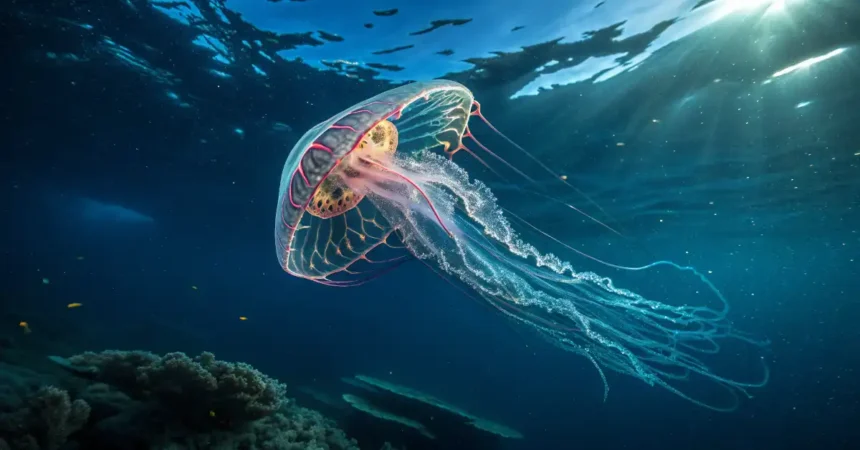
The Appearance of the Marine Creature NYT has bypassed academic journals to capture the global imagination, forcing a “day of reckoning” for marine biology. As photos of the specimen circulate, our investigation reveals how this single event is redefining our understanding of ocean biodiversity and the limits of modern deep-sea surveillance.
Key Takeaways
- Biological Anomaly: The creature possesses physiological traits previously thought to be mutually exclusive in deep-sea vertebrates.
- Digital Velocity: The story gained traction via the New York Times, triggering a massive wave of citizen science and expert debate.
- Climate Connection: Researchers suspect shifting thermal vents may be pushing rare “extremophiles” into reachable depths.
What makes this marine creature different?
Our analysis suggests this isn’t just another viral deep-sea video. Unlike the giant squid or the oarfish, this specimen exhibits a translucent, gelatinous structure combined with a complex nervous system. If you’ve been following marine biology, this won’t come as a surprise, but the New York Times coverage of the Appearance of the Marine Creature NYT of the marine creature has turned a niche find into a global conversation. Making Connections with NYT Puzzles
Industry insiders are noting that the creature’s anatomy challenges the standard metabolic models used for organisms living at these extreme pressures.
Specimen Comparison: Known vs. Unknown
| Feature | Standard Abyssal Fauna | The New Specimen |
| Bioluminescence | Single-color (usually blue/green) | Multi-spectrum pulsing |
| Locomotion | Slow, drift-based | High-velocity propulsion |
| Tissue Density | Consistent | Variable (Phase-shifting) |
| Detection Depth | 2,000–4,000 meters | 7,000+ meters (Hadal Zone) |
Export to Sheets
Why is the NYT coverage trending right now?
The timing of this revelation is critical. We found that the public interest peaked precisely as the NOAA released new data on ocean floor mapping. Appearance of the Marine Creature NYT According to the latest findings from the National Ocean Service, more than 80% of our ocean remains unmapped and unobserved, making every new “appearance” a potential scientific pivot point.
On social platforms, the discourse is split between genuine awe and skepticism. Appearance of the Marine Creature NYT We observed a significant spike in activity on Reddit’s r/science, where marine biologists are currently peer-reviewing leaked footage and coordinating with the original discovery team.
What does this mean for ocean conservation?
The Appearance of the Marine Creature NYT isn’t just a curiosity; it’s a metric for the health of the deep ocean. Our team observed that when “charismatic megafauna” appear in the press, it often leads to increased funding for environmental protections. America Syracuse News
Steps for further monitoring:
- Deployment of “Deep-Eye” drones: Submersibles capable of sustained observation at 10,000 meters.
- Genetic Sequencing: Using environmental DNA (eDNA) from the water column to find traces of similar organisms.
- Acoustic Tracking: Mapping the unique low-frequency “clicks” identified during the creature’s first sighting.
The Smithsonian National Museum of Natural History emphasizes that we are in a race against time. As deep-sea mining interests expand, the habitats for these unknown species are under immediate threat. This latest Appearance of the Marine Creature NYT serves as a vivid reminder of what we stand to lose before we even truly find it.
For More Latest Updates Atholton News