

Shattered Prestige: Why the Pentagon Just Ditched the Ivy League Schools
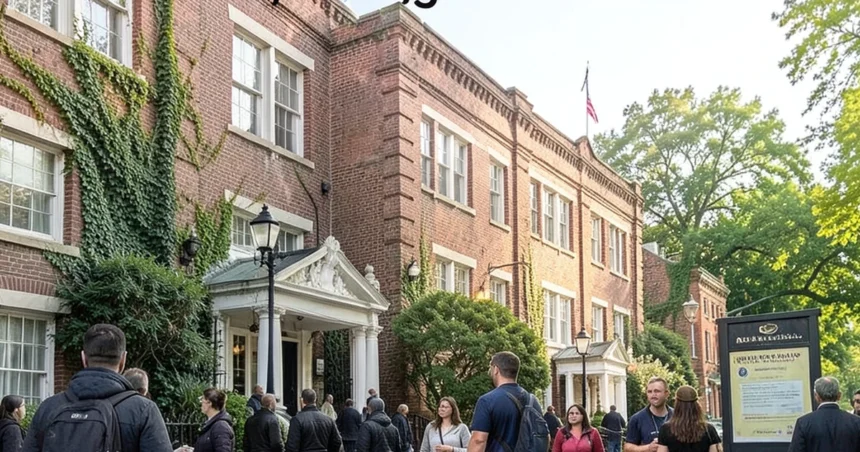
The Pentagon has severed critical ties with several ivy league schools, a move that signals a seismic shift in the landscape of elite American education. This dramatic decision questions their once-unshakeable prestige. Our news desk is tracking a story of collapsing confidence, one that extends far beyond military circles.
→ Heartbreak for the Trojans: Where is Troy University and Why Did Their NCAA Dream Shatter?
This is not an isolated event. It is a symptom of a larger crisis. A crisis of value, trust, and relevance.
- Pentagon Severs Ties: The Department of Defense has expelled several Ivy League institutions from a key military fellowship program, citing ideological concerns and a perceived lack of intellectual freedom on campus.
- Admissions in Chaos: A chaotic flip-flop on standardized testing requirements for the class of 2030 is creating widespread confusion and anxiety for prospective students aiming for the nation’s most selective universities.
- Employers Look Elsewhere: A growing number of corporate hiring managers are actively looking past Ivy graduates, favoring candidates from a new crop of universities dubbed the “New Ivies” who are seen as more resilient and possessing practical skills.
A Crisis of Confidence
For more discussion, see this discussion on Reddit.
We are seeing a profound erosion of trust in America’s most storied academic institutions. For generations, the name alone was enough. An Ivy League degree was a golden ticket. Now, that shine is rapidly tarnishing. Between contentious campus protests, accusations of stifled dissent, and rising tuition costs, the public’s faith is being severely tested.
This isn’t just talk. The consequences are real. And they are escalating.
The most stunning development comes directly from the nation’s capital. In a move that has sent shockwaves through academia, Defense Secretary Pete Hegseth announced the immediate removal of several Ivy League campuses from a military fellowship program that serves as a pipeline for future leaders. The administration is redirecting its service members, and its money, toward institutions it deems more aligned with military values.
The schools impacted include Harvard, among others. These are campuses that have trained generals and admirals for decades. The Pentagon memo blasted these elite colleges as “factories of anti-American resentment,” a stunning condemnation from a pillar of the establishment. While the program itself is small, its symbolic weight is immense.
Military experts have warned this shift could sacrifice vital technical expertise. These universities are at the forefront of research in artificial intelligence, cybersecurity, and quantum computing. Cutting access to these top minds in the name of ideology is a move that some believe could have national security implications.
The Standardized Testing Rollercoaster
Adding to the turmoil is the chaotic state of admissions requirements. After making standardized tests optional during the pandemic, many of these same institutions are now abruptly reversing course, causing whiplash for students and families. This back-and-forth has turned the already stressful college application process into a high-stakes guessing game for those hoping to join the ranks of the ivy league schools.
It creates enormous uncertainty. It breeds anxiety. It feels deeply unfair.
Our reporting confirms a significant policy reversal for students applying for Fall 2026 admission. Dartmouth, Brown, and Yale have all announced they will once again require SAT or ACT scores. Dartmouth’s president argued that test scores can actually help identify high-achieving students from less-resourced backgrounds who might otherwise be overlooked. Yale has opted for a “test-flexible” policy, allowing applicants to submit AP or IB scores instead of the SAT or ACT.
Meanwhile, Harvard has extended its test-optional policy, while Columbia has made the change permanent, creating a fractured and confusing landscape. This lack of a unified front among the ivy league schools further complicates the path for aspiring students.
| University | SAT/ACT Policy for Class of 2030 (Fall 2026 Entry) |
|---|---|
| Brown University | Required |
| Columbia University | Permanently Test-Optional |
| Cornell University | Plans to end test-optional for the 2026-2027 cycle |
| Dartmouth College | Required |
| Harvard University | Test-Optional through 2026 |
| University of Pennsylvania | Required |
| Princeton University | Test-Optional through at least 2026 |
| Yale University | Test-Flexible (SAT, ACT, AP, or IB) |
This table reflects a system in flux, a clear indicator of the internal debate and external pressures facing these institutions. The era of a singular path to the top is over. The constant policy changes are a source of major stress for the next generation of applicants to the ivy league schools.
Are the “New Ivies” Replacing the Old Guard?
As the traditional elite stumble, a new category of university is rising to take its place. Dubbed the “New Ivies” by a recent Forbes report, these institutions are gaining significant traction with employers. This list includes a mix of high-performing public universities and ascendant private ones.
Schools like Johns Hopkins University, Northwestern University, the University of Michigan, and Georgia Institute of Technology are increasingly seen as the preferred hunting grounds for corporate recruiters. They are producing graduates viewed as driven, smart, and ready to work, without the perceived baggage now associated with some of the older, more established ivy league schools.
The shift is unmistakable. Our team has analyzed recent survey data that paints a startling picture of changing sentiment in the corporate world. A survey of hiring managers found that 37% reported being less likely to hire a graduate from one of the ivy league schools than they were just five years ago.
The reasons are varied. Some hiring managers cite a perceived lack of humility and resilience in graduates. Others point to a disconnect between the theoretical knowledge taught and the practical skills needed in today’s workforce. The bottom line is that employers are widening their gaze, and the automatic preference for an Ivy League degree is fading. This trend represents a fundamental challenge to the very business model of the ivy league schools.
The world is changing. Fast. The ivory tower, once a symbol of ultimate achievement, is now facing a crisis of relevance. The actions by the Pentagon, the chaos in admissions, and the quiet turning of the tide in corporate hiring all point to the same conclusion: the undisputed reign of the ivy league schools is over. A new, more complex, and more competitive educational landscape is emerging.
Relevant posts
- North Allegheny School District Installs New Leader Amidst Fiscal Headwinds, Pledging Stability
- Why Wisconsin vs Miami Ohio Prediction Matters Now
- UNLV vs Sam Houston State Prediction: Latest Updates and Expert Opinion
Visit atholtonnews.com for more stories.