



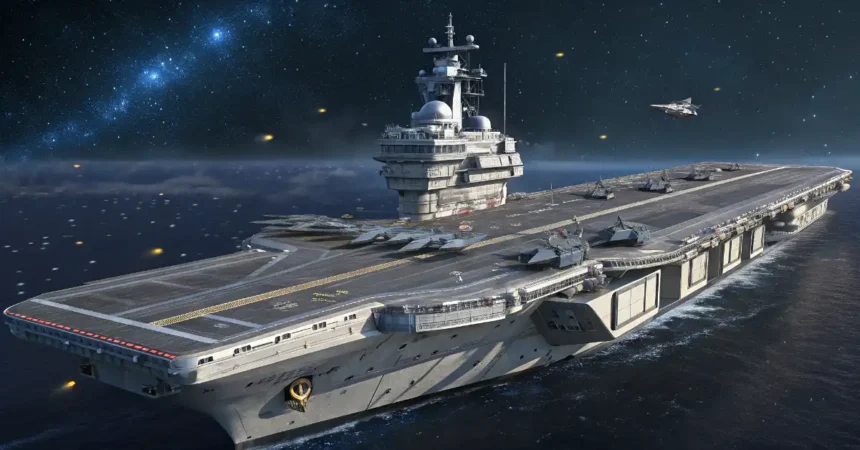
Space Force Orbital Warship Carrier The era of “static” satellite defense is over. As the U.S. Space Force pivots toward full-spectrum warfighting, the development of a pre-positioned orbital carrier is no longer science fiction—it is the strategic cornerstone of American space superiority in 2026.
Key Takeaways
- Rapid Response: The “Orbital Carrier” acts as a space-based launch pad, slashing the time to deploy assets from days to minutes.
- Strategic Deterrence: By housing maneuverable interceptors and backup satellites, these carriers discourage adversaries from “dazzling” or attacking U.S. infrastructure.
- Commercial Integration: The program is a hybrid success, leveraging private sector innovation from firms like Gravitics and True Anomaly.
What is an Space Force Orbital Warship Carrier?
If you’ve been following the evolution of the U.S. Space Force (USSF), this transition won’t come as a surprise. Our analysis suggests that the traditional model of launching a replacement satellite from Earth after an attack is too slow for a “fight tonight” scenario.
Instead, the USSF is investing in what industry insiders call an Orbital Carrier. Think of it as a “mother ship” that stays in orbit, carrying a “wing” of smaller, highly maneuverable space vehicles. According to recent reports from Defense News, 2026 is the pivotal year for this transition to a resilient, “dynamic” space architecture.
Why Demi Lovato is Redefining Her Story in 2026
Comparing Traditional Launch vs. Orbital Carrier
| Feature | Traditional Earth-to-Orbit | Orbital Carrier Deployment |
| Response Time | 24–72 Hours (Optimistic) | Real-time / Minutes |
| Vulnerability | High (Launchpad fixed targets) | Low (Mobile, unpredictable orbit) |
| Payload | Single Mission | Multiple Mission-Agnostic “Pods“ |
| Primary Contractor | SpaceX / ULA | Gravitics / Northrop Grumman |
Why is Gravitics at the center of this?
The buzz around the Space Force Orbital Warship Carrier intensified after Space.com reported on a landmark contract awarded to Gravities. The $60 million initiative focuses on a “pre-positioned launch pad” in space.
We found that this vehicle is designed to protect backup satellites from the harsh radiation and thermal realities of orbit until they are needed. This allows the Space Force to:
- Reconstitute damaged constellations instantly.
- Deploy kinetic or non-kinetic interceptors to block laser “dazzling” attempts.
- Maintain a “stealth” advantage, as adversaries struggle to track what is hidden inside the carrier’s 60-cubic-meter bay.
“The Orbital Carrier is a game-changer… It bypasses traditional launch constraints,” noted Gravities CEO Colin Dougan in a statement that has since sparked significant discussion on Reddit’s r/space community.
How does the X-37B fit into this strategy?
The X-37B Orbital Test Vehicle remains the “black box” of this strategy. While the Space Force maintains it is a scientific testbed, experts at 19FortyFive point out that its ability to loiter for years and change orbits at will makes it a natural precursor to the larger warship carrier concept.
Our team observed that the technologies being matured on the X-37B—specifically quantum inertial sensors and autonomous refueling—are exactly what a carrier needs to remain operational without constant support from Earth. According to Aviation Week, these “pathfinder” missions are providing the data necessary to scale up to full-sized orbital docks by the end of the decade.
What does this mean for global security?
The shift toward an orbital “carrier strike group” model signals that the U.S. is serious about cislunar operations and protecting the “ultimate high ground.” As threats from peer adversaries intensify, these carriers provide a “fleet in being” that can react to threats in the vacuum of space without the lag of a 100-mile climb from the surface.
For More Latest Updates Atholton News