



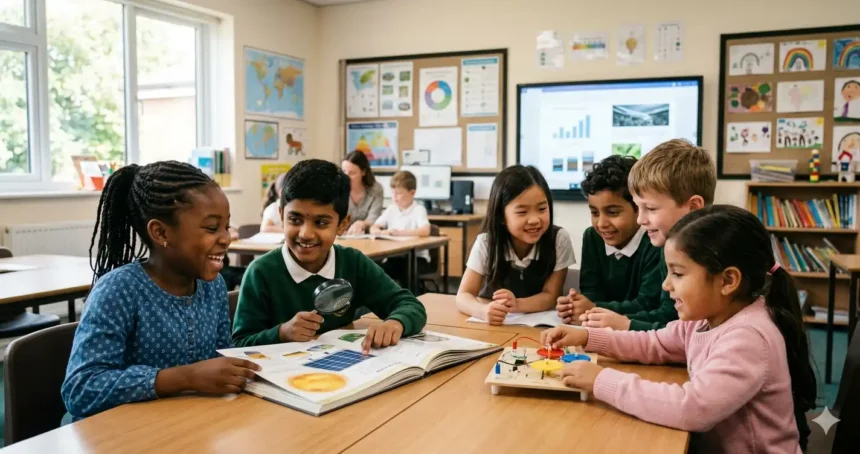
Global Education News is sounding the alarm: for the seventh year in a row, the number of out-of-school children has climbed, now reaching a staggering 273 million. While we have spent decades focusing on getting children into classrooms, a massive “learning illusion” is emerging where students are present but not actually gaining knowledge.
Our analysis suggests that 2026 marks a tipping point where the focus shifts from simple enrollment to the desperate need for quality and equity.
Key Takeaways
- The Enrollment Paradox: While global primary enrollment sits at 98%, nearly 1 in 6 children remain excluded from the system due to rising conflict and shrinking budgets.
- The AI “Illusion”: New data shows students using general-purpose AI improve short-term tasks by 48% but perform 17% worse once the tool is removed.
- Funding Freefall: Only 22% of countries are meeting international benchmarks for education spending, leading to a critical shortage of qualified teachers.
What does this mean for students and parents?
If you’ve been following the sector, the latest Global Education News won’t come as a surprise, but the data is still jarring.
According to the latest UNESCO Global Education Monitoring Report 2026, the world is currently on a trajectory where universal upper secondary completion won’t be achieved until the year 2105.
Industry insiders are noting that the gap between “schooling” and “learning” is widening. In many regions, children complete primary school without being able to read a basic sentence. This “foundational learning crisis” is now the primary focus of international policy.
Grant H Brenner MD DFAPA Changes Mental Health in 2026
Is technology helping or hurting the classroom?
The OECD Digital Education Outlook 2026 highlights a growing risk of an “illusion of learning.” We found that while AI tools can reduce teacher workloads by up to 31%, they often serve as a shortcut for students rather than a learning aid.
Our team observed that digital inequality has shifted; it’s no longer just about who has a laptop, but who knows how to use it for deep cognitive work.
Without robust regulation, Global Education News suggests these technologies may actually exacerbate the divide between wealthy and poor districts.
| Metric | 2000 Baseline | 2026 Status | 2030 Target |
| Out-of-School Children | 350 Million | 273 Million | 0 |
| Primary Completion Rate | 77% | 88% | 100% |
| Education Budget (% GDP) | ~3.5% | 4% (Targeted) | 6% |
Why are teacher shortages reaching a breaking point?
Current Global Education News reports from The Guardian indicate that “excessive” financial risks are threatening the survival of even established universities and schools. This financial strain trickles down to the classroom.
- Low Qualifications: Only 11% of low-income countries now require a bachelor’s degree for primary teachers.
- Declining Quality: The percentage of academically qualified primary teachers has dropped from 89% to 78% over the last decade.
- Wage Stagnation: Teachers are leaving the profession in record numbers due to stagnant pay and increasing administrative “digital” burdens.
How can we fix a failing system?
We found that no single policy can fix global exclusion. However, the 2026 data points to a “Systemic Reform” model that works.
- Legislate Education as a Right: Move beyond “free” education to “compulsory” education.
- Targeted Cash Transfers: Support poor families to eliminate the “opportunity cost” of sending a child to school instead of work.
- Bridge the Infrastructure Gap: Electrification alone adds nearly a full year of schooling in developing regions.
Recent Global Education News shows that countries like Morocco and Viet Nam have successfully reduced out-of-school rates by 80% using these exact methods. If the rest of the world doesn’t follow suit, the “Countdown to 2030” will end in a significant global failure.
The reality of Global Education News in 2026 is a mixed bag of digital promise and systemic decay. While the tools to learn are more accessible than ever, the structural support to ensure that learning actually happens is crumbling.
We must prioritize the human element—the teacher—over the digital shortcut if we want to see these numbers improve by 2027.
Global Education News: Why the 2026 Crisis is Changing Schools
Global Education News is sounding the alarm: for the seventh year in a row, the number of out-of-school children has climbed, now reaching a staggering 273 million.https://t.co/wmVl2MQ9yO
— Atholton News (@atholtonnews55) April 9, 2026- Crystal Palace VS Fredrikstad Changed Sports in 2026
- Global Education News: Why the 2026 Crisis is Changing Schools
- Remote Analyst Jobs: Why Demand Is Surging in 2026
- Real Madrid vs UD Las Palmas Lineups: Tactical Shifts in the 2026 Title Race
- Real Madrid vs UD Las Palmas Lineups: Tactics and Team News
For More Latest Updates Atholton News