



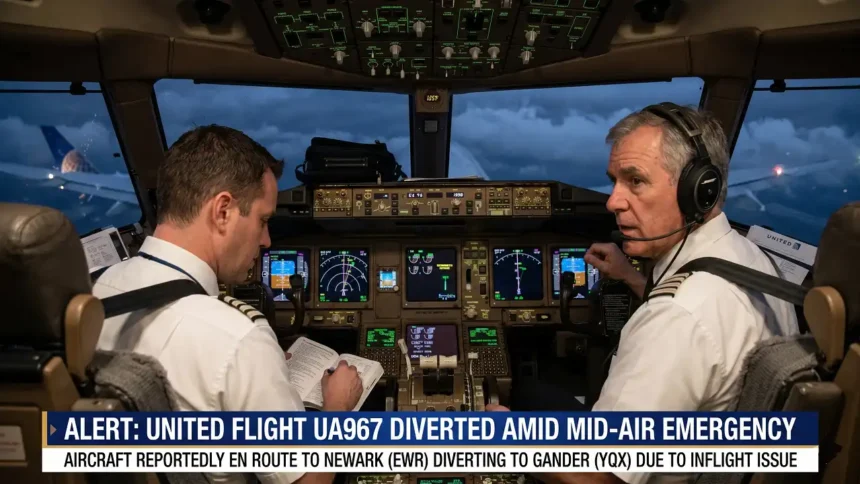
United Flight UA967 diverted to Canada last summer, and the question readers keep asking is simple: was anyone hurt, and what caused it? The short answer is no injuries, and a technical fault over the Atlantic.
Here is what the flight records actually confirm.
Key Takeaways
- A Boeing 767-300ER flying Naples to Newark landed safely at St. John’s, Newfoundland on August 24, 2025.
- The crew diverted for a technical reason after about seven hours over the ocean; no injuries were reported.
- Passengers reached Newark Liberty on a replacement 767, more than 10 hours behind schedule.
What actually happened to UA967?
UA967 is a scheduled transatlantic flight from Naples (NAP) to Newark (EWR).
On August 24, 2025, the jet pushed back from gate B10 roughly three hours late.
Mid-ocean the crew flagged a fault and turned toward St. John’s International Airport, the nearest suitable runway.
| Time (local) | What happened |
| Aug 24, 17:13 CEST | Departs Naples from gate B10, about 3 hours late (reg. N671UA) |
| + ~7 hours | Crew diverts over the Atlantic for a technical reason |
| 20:25 NDT | Lands safely at St. John’s, runway 28 |
| Aug 25, 04:40 EDT | Replacement 767 reaches Newark, 10+ hours late |
Why was the flight sent to St. John’s?
Over open water, crews do not wait and see. Twin-engine jets follow ETOPS rules and must stay within reach of a usable airport at all times.
St. John’s fit that window, so the diversion was the standard aviation safety move, confirmed in the original AIRLIVE report.
Flight at a glance
| Detail | Information |
| Flight | United UA967 |
| Route | Naples (NAP) → Newark (EWR) |
| Diversion airport | St. John’s, Newfoundland (YYT / CYYT) |
| Original aircraft | Boeing 767-300ER, reg. N671UA |
| Replacement aircraft | Boeing 767, reg. N673UA |
| Date | August 24–25, 2025 |
| Reported cause | Technical (specifics not officially detailed) |
| Injuries | None reported |
What does this mean for passengers?
Because the trip began in Italy, passenger rights rules can be stronger than many US travelers expect.
Our reading of the public guidance is that two frameworks may apply, depending on where you are protected.
| Where | Rule | May cover |
| Departing Italy | EU261 (EU rights) | Meals, hotel, rebooking, possible cash compensation |
| US arrival | US DOT rules | Rebooking and refunds for cancelled service |
Smart steps if your flight diverts
- Save every receipt for meals, transport, and hotels in case you file a claim.
- Watch the airline app for gate, rebooking, and voucher updates in real time.
- Check your EU261 eligibility when a flight starts in Europe and the cause is technical.
- Track the tail number on FlightAware so you know where the aircraft actually is.
The bottom line: a diversion feels dramatic, but UA967 ended the way that matters most, on the ground and safe.
Read More: