



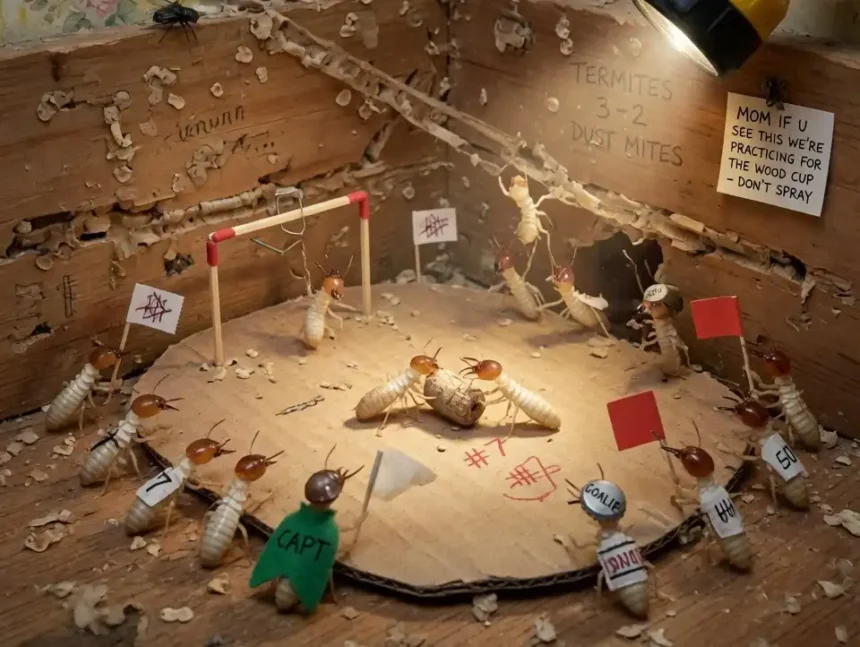
Imagine this: somewhere behind your walls, under your floors and along your foundation, a low-grade but constant “game” is taking place. Workers are digging through wood like midfielders splitting the defense-little cream-colored bots dressed in khakis; guards stand watch like defenders; and reproductives sometimes “kick off” in waves that herald another season of destruction.
And they aren’t actually playing football, of course-but the metaphor fits uncomfortably well. Termites act like a unit, are shielded by infrastructure (via mud tubes), and have an objective: destroy the cellulose in your home until it begins to collapse.
If you’re ready to think beyond the scoreboard and start winning against termites, you’re in the right place.
Most homeowners never see the players until the damage is already done. The termites seldom come out in the open. They operate in shadows smothered by moisture, sometimes for years until people experience hollow-sounding floors, painted peeling away or a colony of winged bugs buzzing toward a window.
Termites cause several billion dollars in structural damage each year in the United States, and also cost hundreds of millions more for control. The good news? With early detection, and proper Interventions by Professionals, the game can be stopped before the final whistle is blown.
Who Are These “Players”? Understanding Termite Biology
Termites are social insects that live in well-established colonies. The three “castes” are workers (the ones doing the real damage eating wood), soldiers (with larger heads and powerful jaws for colony defense), and reproductives (kings, queens, and swarmers).
Subterranean termites – the most common and destructive type in the US—are found mainly underground, where they enter your house through tunnels or mud tubes they build to keep them safe from light.
Drywood termites invade wood and do not require contact with soil to survive. They drop their six-sided pelletshighly distinctive fecal pellets (also called frass) onto the ground below.
Dampwood termites are more severe wood problems while not as common in homes, they indicate significant moisture issues. A crucial difference that a great deal of people error is that termite swarmers are usually mistook for flying ants. Termite wings are about the same length and its antennae are straight or droopy, while an ant has front wings long than hind wings along with elbowed antennae, according to the U.S. Environmental Protection Agency. It is important to get this identification correct; confusing the two can lead to delays in effective treatment.
3 Worrisome Signs Termites Are Calling The Shots In Your Walls
Early warning signs are what you have the ability to defeat. Thus, here are the game-changing signs that termites have transformed your house into their stadium:
Protective Sidelines-Mud Tubes Pencil-thick (or thicker) earthen tunnels running along foundation walls, piers, sill plates or even dangling down from floor joists. These shelter tubes keep moisture levels high and they also shield termites from the dry air as well as predators. If the infestation is active, breaking one open could expose live workers inside, but an empty tube doesn’t mean the colony has disappeared; it’s common for termites to abandon a segment and forage farther away.
Hollow Echo Fumble-Tapping or probing wood by feeling it with a screwdriver gives you the softness of paper instead of solid resistance. Galleries are oriented and filled with soil, excrement. In advanced instances, wood can appear to be blistered, sagging or darkened on the outside but completely hollow on the inside.
Drywood Termites Frass “Field Goals”-For drywood ones, check for little piles of fine, sandy or hexagonal pellets pushed out through kick-out holes. These fecal pellets might be on window sills, beneath furniture or on the flooring under contaminated trim or beams. If you have just cleaned an area and fresh pellets show up, this is a strong indicator of continued activity.
Indoor Swarmer Kickoff —Discovering swarming winged termites or discarded wings inside your house (especially near lights or window around late winter till early summer) more often than not means an unharbored colony in close range. Outdoor swarms around stumps or wood piles are worrisome, but not as critical as an indoor swarm.
Creepy Structural Soft Spots-Doors that suddenly don’t close well, floors that feel spongy or unusually uneven, or paint bubbling along baseboards can all indicate concealed termite tunnels compromising the wood behind the wall coverings.
Live Workers or Soldiers Present-If you discover creamy-white workers or larger-headed soldiers when probing wood or tubes, an infestation is present. Tunnelling these insects shun light and dry conditions so when witnessed suggests many or near the surface.
University extension services stress that any one indicator is considered inconclusive alone-professional inspection is the surest means of determining the true severity of play.
The True Price of Allowing the Game to Proceed
Termites do not eat overnight. Before apparently significant structural destruction occurs, a colony can live for between 5–10 years or more responsible feeding. They go after structural lumber, floor joists, subflooring, door and window frames and even cellulose in drywall or insulation. When they get serious, they can threaten load-bearing timbers-causing sagging floors, cracked walls or (rarely, but with disastrous consequences) partial structural failure.
In addition to repair costs, termites can harm your home value, insurance claims (many policies specifically exclude termite damage as a maintenance failure), and your peace of mind. The longer that the ‘match’ continues, the more invasive and expensive eventual treatment is.
Reason Why the termite Chose Your Home
Termites are opportunists. They prosper where moisture, cellulose and accessibility occur. Common attractors include:
- Contact with the ground for example wood touching the soil (deck posts, lattice trellises or siding)
- Excess moisture from poor drainage, leaking gutters or plumbing that preserves soil or wood in a suspended state of dampness
- Firewood stacks, tree stumps or construction debris close to the foundation
- Cracking, foundations, utility entry point and expansion joints
- Mulch banks against the house or not enough ventilation in crawl spaces
And newer homes aren’t off the hook either particularly if construction debris was buried or soil wasn’t well graded. Formosan termites (which are an invasive species for parts of the South and coastal regions) will actually build aerial colonies within attics or walls if they can find moisture to colonize.
Halftime Adjustments: Practical Prevention Strategies
It is cheaper to prevent than remediate. Make your home less inviting:
- Barrier – Keep a 6-18 inch space clear between soil and wood siding, sheathing or decking.
- Repair leaks as soon as they are found, re-pitch to encourage water flow away from the foundation, and make sure gutters and downspouts work correctly.
- Keep firewood, stumps and wood debris at least several feet from the structure; remove them. Use pressure-treated wood or non-cellulose alternatives where the wood and soil will interact.
- Seal cracks and voids in foundations, and around utility penetrations.
- Use dehumidifiers or vapor barriers in humid climates, and keep crawl-space vents clear.
- The annual professional inspection plan is suggested-most especially when buying or selling a home and after any moisture event (flood, leak or heavy rain).
According to the EPA, reduction in conducive conditions is one of the most effective long-term strategies.
So, you know when to call in the professionals: helping your options and good accurate costs!
It is almost always a good idea for homeowners to not try pest control on their own. Effective treatment involves specialized equipment, registered vehicles, and correctly-trained technicians, as well as local understanding of the various termites that inhabit their area (as species vary by region) and the soil conditions that effect product viability. Common professional approaches include:
Liquid soil barriers – Termiticide is introduced into the ground in a trench along foundations and injected under slabs or into foundation walls to produce a barrier that kills or repels termites trying to cross it.
Baiting-Slow-acting toxicants are put into the soil in stations. These are known as “foraging termites” and they transport the substance back to their colony, which could make it disappear after a few days or weeks. Baits typically get used together with liquid treatments or in environmentally sensitive locations.
Fumigation (tenting) – Used mostly for drywood termites; the entire home is covered with a tent and gassed throughout the wood.
The best companies are good for a 1-to-5-year warranty (sometimes more), plus an annual or periodic inspection. These warranties are renewable, but they tend to have the homeowner maintaining certain conditions (no new construction debris, leaks fixed quickly as necessary, etc.). If the conditions are not dealt with, especially in some parts of the world, treatment failure rates may be up to 20–30%, which is what makes continued follow-up relevant.
Most home owners will use special online tools to find out the cost of a professional termite treatment in your local area whether you need a full liquid barrier, bait system or combination method. To get a custom estimate using your home size, foundation type and other criteria go to the interactive pest control price calculator at pestcontrolprice.com.
The right professional intervention + intelligent avoidance = the win.
When the Final Siren Blows, Don’t Let it be on Your House Kicking the Bucket
As long as the weather permits, termites will continue to “practice,” spreading further and more systematically. The longer you wait, the more wood they eat and the costs of eventual repairs and treatment rises. But unlike a real match you know that there is no clock running out in your favour the metaphor of a football game here is helpful because it emphasises the collective and persevering nature of the threat. The game will continue as long as you sit idly by.
Have a comprehensive professional inspection today. Inquire about the exact kind of termites you’ve encountered, the degree of any destruction that has happened, the treatment package, guarantee specifics and what continuous prevention measures you have to follow. In other words, early intervention is generally much less disruptive-and far cheaper-than waiting until those “injuries” become visible.
The biggest asset you have is your home. Make sure unseen players do not turn it into their home field advantage. Termites will run circles around you if you do not kick them out long before they get that winning goal against your foundation, your finances and all that is precious to you.