



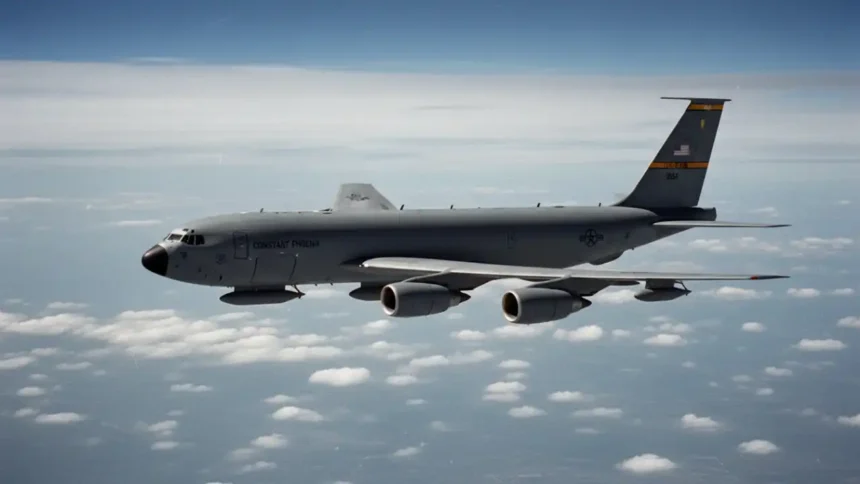
A US Air Force WC-135R Constant Phoenix declared a mid-air emergency over Northern Europe on February 17, 2026. The rare nuclear detection aircraft, known as the “nuke sniffer,” dropped from 33,000 feet and landed safely at RAF Mildenhall.
No injuries were reported, and the cause remains undisclosed.
Key Takeaways
- The WC-135R (reg. 64-14831) declared an emergency at 11:10 UTC and landed at 11:48 UTC with no injuries.
- The aircraft is one of only a handful of atmospheric collection planes that support the nuclear test ban treaty.
- The US Air Force has not released the cause, according to flight data tracked on Flightradar24.
What Happened During the Flight?
We tracked the full sequence of events below. The emergency unfolded over roughly four hours, from takeoff to a safe touchdown at the Suffolk base.
| Time (UTC) | Event |
|---|---|
| 07:20 | Takeoff, climb to 33,000 ft over the North Sea |
| ~08:00 | Patrol begins over Norway airspace |
| 11:10 | Crew declares emergency, begins descent |
| ~11:15 | Aircraft levels at 13,000 ft, enters holding patterns |
| 11:48 | Safe landing at RAF Mildenhall, met by ground crews |
The official WC-135 fact sheet is published by the US Air Force.
University of Maryland Graduate Student Union Wins Big in 2026
What Is the WC-135R “Nuke Sniffer”?
The Constant Phoenix is built for one job: detecting radioactive particles in the air. We broke down its core mission roles into concrete capabilities.
| Capability | Detail |
|---|---|
| Nuclear detection | Detects radioactive “clouds” in real time |
| Treaty verification | Supports the Limited Nuclear Test Ban Treaty of 1963 |
| Disaster monitoring | Tracked Chernobyl (1986) and Fukushima (2011) fallout |
| Air sampling mission | Collects particles on filter paper and stores whole-air samples |
The crew flies the air sampling mission from the 45th Reconnaissance Squadron at Offutt Air Force Base.
College Readiness Starts in Kindergarten: The 2026 Shift
How Does the Aircraft Measure Up?
This airframe is old, but its mission gear is current. Here are the verified specifications drawn from the official record.
| Specification | Figure |
|---|---|
| Registration | 64-14831 |
| Airframe age | ~61 years (early 1960s build) |
| Variant | WC-135R (converted from KC-135R) |
| Engines | Fuel-efficient CFM-56 turbofans |
| Wingspan | 130 ft, 10 in (39.8 m) |
| Range | ~4,000 nautical miles |
| Cruise speed | 403 mph (350 knots) |
The “R” models replaced aging C and W variants, per the US Air Force inventory data.
Michigan and Arizona: Why These Powerhouses Define the 2026 Shift
What Does the Fleet Status Tell Us?
The Constant Phoenix is one of the rarest assets in the US inventory. That scarcity is exactly why this emergency drew attention.
| Fleet Detail | Status |
|---|---|
| Active aircraft | Small fleet, recently modernized |
| Air National Guard | 0 |
| Reserve | 0 |
| Primary base | Offutt AFB, Nebraska |
| Unique role | Only US aircraft conducting air sampling |
Industry insiders are noting that deployments of this nuclear detection aircraft often line up with heightened tensions in the region.
Cheltenham Youth Detention Commission: Why It Matters in 2026
What This Means Going Forward
We found no evidence of a serious failure in the public record. The crew followed standard procedure: descend, hold to manage fuel and run checklists, then land.
Here is what we are watching:
- Official cause: The US Air Force has not disclosed the technical issue.
- Airframe age: At 61 years old, maintenance scrutiny on the Constant Phoenix fleet will likely grow.
- Mission continuity: With so few aircraft, any downtime affects the atmospheric collection mission.
We will update this report as the US Air Force releases further detail on the WC-135R emergency.
For More Latest Updates Atholton News