



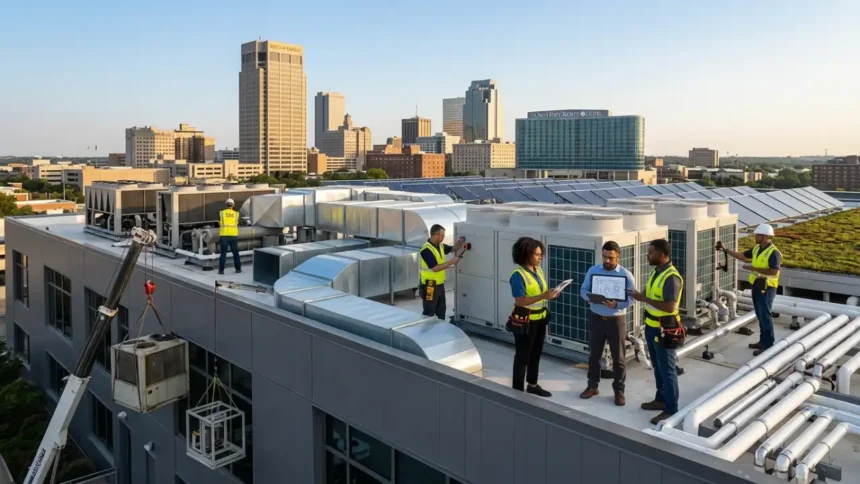
New refrigerant rules and code updates are reshaping commercial HVAC in Fort Worth this summer. The EPA’s R-410A final rule takes effect July 27, 2026, and building owners here face real decisions now.
We found the changes affect budgets, permits, and equipment timelines all at once.
Key Takeaways
- The U.S. commercial HVAC market is projected to reach roughly $282 billion in 2026, driven by efficiency upgrades and electrification.
- EPA’s amended R-410A rule becomes effective July 27, 2026, allowing pre-2025 units to be installed until supplies run out.
- Fort Worth enforces the 2021 International Mechanical Code, with mechanical permit fees tied directly to system tonnage.
Why the Market Matters Now
The commercial HVAC market is growing fast, and Texas sits near the center of that growth. Nationally, spending is climbing toward $282 billion, according to industry tracking data.
Our analysis suggests Fort Worth owners feel this through higher demand for efficient rooftop units and chillers. The U.S. Energy Information Administration reports ventilation and space cooling account for a combined 26% of commercial electricity use.
| Market Metric | 2026 Figure |
|---|---|
| U.S. commercial HVAC market | ~$282 billion |
| Commercial cooling share of electricity | 11% |
| Commercial ventilation share | 15% |
| Projected annual U.S. electricity demand growth | ~2% |
Check Also – Budweiser Super Bowl Commercial 2026 Wins Big
The Refrigerant Transition Explained
The biggest news for commercial HVAC in Fort Worth is the refrigerant shift. The industry is moving from R-410A to A2L refrigerants under the AIM Act of 2020. Per NAHB reporting from May 26, 2026, existing R-410A units made before Jan. 1, 2025 can still be installed until stock runs out.
We recommend confirming supply before you commit to older equipment.
| Milestone | Date |
|---|---|
| A2L transition requirement begins | Jan. 1, 2025 |
| EPA amended R-410A rule effective | July 27, 2026 |
| Window AC final sale date | Jan. 1, 2028 |
| R-410A production down to 15% | 2036 |
Check Also – Three Boaters Dead After Pontoon Collides with Commercial Barge on Lake Pepin
Fort Worth Codes and Permit Fees
Fort Worth adopted the 2021 International Mechanical Code, per the city code library. Energy compliance follows the Fort Worth Energy Code, based on the 2015 IECC with ASHRAE 90.1 as the commercial path. We track these rules closely so your project passes inspection the first time. Mechanical permit fees scale with equipment capacity, and we break the common ones below.
| HVAC Work | Permit Fee |
|---|---|
| Condensing/chiller unit, up to 2 tons | $5.81 |
| Rooftop cooling only, up to 3 tons | $9.85 |
| Rooftop heating + cooling, up to 3 tons | $19.72 |
| Automatic fire-extinguishing system | $31.37 |
Check Also – Elizabeth Warren xAI Pentagon Letter: The 2026 Impact
What This Means for Building Owners
Here is what we advise for commercial HVAC in Fort Worth projects starting this year. The concern is timing, and the fix is planning your equipment order against the July 27 deadline.
- Confirm refrigerant type before purchase, since A2L systems are now the forward path.
- Budget for energy code inspections, including duct R-value and HVAC efficiency checks.
- File mechanical permits early, because fees depend on tonnage and system type.
The Fort Worth energy code requires documented equipment efficiencies at plan submittal.
We do not leave compliance to chance.
Our Bottom Line
The market for commercial HVAC in Fort Worth is expanding while the rules tighten at the same time. Refrigerant changes, code enforcement, and rising cooling demand all land in 2026 together.
We stand behind projects that plan for both the EPA timeline and local permit requirements. For owners and facility managers, the message on commercial HVAC in Fort Worth is simple: plan early, verify equipment, and document compliance before you build.
For More Latest Updates Atholton News