



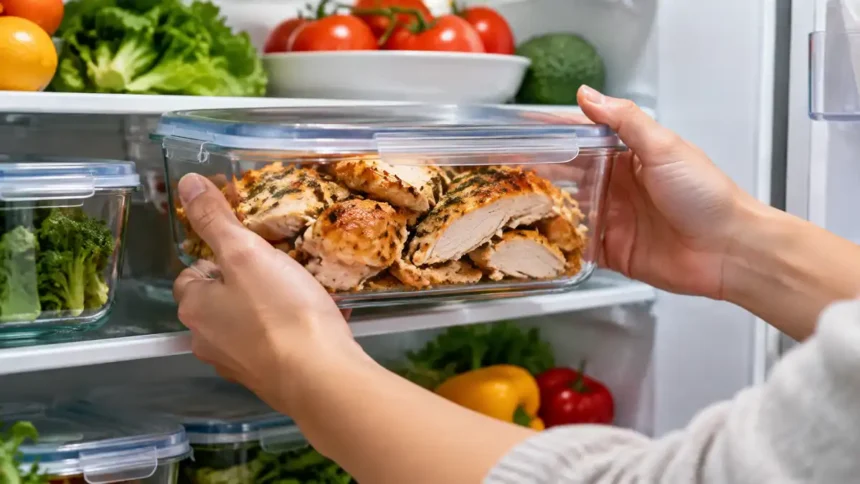
Summer heat waves and backyard cookouts are filling refrigerators with leftover chicken right now. So how long is cooked chicken good for in the fridge? Federal food safety guidelines set a firm limit of 3 to 4 days at 40°F or below. Miss that window, and you are gambling with foodborne illness.
Key Takeaways
- Cooked chicken stays safe for 3 to 4 days in a fridge held at 40°F or below.
- Refrigerate leftovers within 2 hours, or within 1 hour when it is above 90°F outside.
- Always reheat leftover chicken to an internal 165°F, checked with a food thermometer.
Why Is This Rule Making Headlines in July 2026?
The average American eats about 80 pounds of chicken each year, and summer is peak season for leftovers. Rotisserie birds, grilled thighs, and fried chicken often sit out too long at picnics. Our analysis suggests most mistakes happen before the food even reaches the fridge.
Bacteria multiply fastest between 40°F and 140°F, the so-called danger zone. If you’ve been following food safety news, this won’t come as a surprise. Heat shortens every safe window.
Health Agencies Warn Consumers About Contaminated Cheese and Baby Wipes
What Does USDA Chicken Storage Guidance Actually Say?
The table below reflects current USDA chicken storage timelines for common products.
| Chicken Product | Fridge (40°F or below) | Freezer (0°F, best quality) |
|---|---|---|
| Leftover cooked chicken | 3 to 4 days | 4 months |
| Fried chicken | 3 to 4 days | 4 months |
| Rotisserie or take-out chicken | 3 to 4 days | 4 months |
| Chicken nuggets or patties | 3 to 4 days | 1 to 3 months |
| Chicken in broth or gravy | 3 to 4 days | 6 months |
| Chicken casseroles or soup | 3 to 4 days | 4 to 6 months |
| Chicken salad | 3 to 5 days | Do not freeze with mayo |
| Deli-sliced chicken | 3 to 5 days | 1 to 2 months |
How Fast Must Leftovers Reach the Refrigerator?
Timing matters as much as cooked poultry shelf life. Outdoor temperatures change the rules fast.
| Situation | Maximum Time Out | Action |
|---|---|---|
| Room temperature | 2 hours | Refrigerate or discard |
| Above 90°F outdoors | 1 hour | Refrigerate or discard |
| Power outage, fridge closed | 4 hours | Discard after 4 hours |
| Full freezer, no power | About 48 hours | Refreeze if ice crystals remain |
| Half-full freezer, no power | About 24 hours | Check with thermometer |
How to Cook Quinoa in Rice Cooker the Right Way
How Can You Tell If Chicken Has Gone Bad?
Industry insiders are noting that people still rely on the “sniff test.” That habit is risky, because bacteria like Salmonella and Listeria often leave no smell at all.
| Warning Sign | What It Means | Verdict |
|---|---|---|
| Sour or off odor | Spoilage bacteria growing | Discard |
| Slimy or sticky texture | Surface bacterial film | Discard |
| Gray or green tint | Advanced spoilage | Discard |
| Visible mold | Contamination | Discard |
| Past 4 days, looks fine | Hidden pathogen risk | Discard |
Federal officials stress one point: never taste food to judge safety. When in doubt, throw it out.
What Are the Rules for Reheating Chicken Leftovers?
Proper reheating chicken leftovers kills most bacteria, but only at the right temperature. A food thermometer is the only reliable test.
| Reheating Method | Target Temp | Key Tip |
|---|---|---|
| Oven | 165°F | Cover to keep meat moist |
| Microwave | 165°F | Stir or rotate for even heat |
| Stovetop | 165°F | Add broth to prevent drying |
| From frozen | 165°F | Takes about 1.5 times longer |
Why the King Cheesecake Recall is Trending Right Now
Which Bacteria Pose the Biggest Threat?
Five pathogens are most linked to chicken. Each can trigger foodborne illness when leftover chicken storage goes wrong.
- Salmonella: Common in poultry; causes fever and cramps.
- Campylobacter jejuni: A leading cause of diarrheal illness.
- Staphylococcus aureus: Spreads from food handlers.
- Listeria monocytogenes: Can grow at fridge temperatures.
- E. coli: Spreads through cross-contamination.
What Steps Should Households Take Today?
Smart refrigerator temperature habits protect your family. Follow these simple steps:
- Set your fridge to 40°F or below and verify it with an appliance thermometer.
- Cut large birds into smaller pieces so they chill quickly.
- Store chicken in shallow, covered containers.
- Label containers with the cook date.
- Freeze extras within 3 to 4 days if you won’t eat them in time.
- Thaw frozen chicken in the fridge, never on the counter.
What Does This Mean for Your Next Meal?
The bottom line is clear. Cooked chicken has a four-day safe window, and summer heat leaves zero room for error. Chill it fast, date it, and reheat it to 165°F. Your leftovers will stay tasty, and your family will stay safe.
- Why Ray Ray’s Hog Pit Filed for Chapter 11 Bankruptcy
- Why Michelle Obama Wore a Custom Fear of God Number Shirt
- Pennsylvania Siblings Face Charges After Police Discovered Hundreds of Rats
- Enterprise Rent A Car Detroit Metro Airport DTW: 2026 Guide
- Ashburn Metrorail Station South Parking Garage: Key Facts
For More Latest Updates Atholton News