



Maryland Enacts Statewide Bell-to-Bell Cell Phone Ban in All Public Schools
→ Maryland Joins 14-State Lawsuit to Block Federal Cuts to School Mental Health Grants
Maryland has officially joined the growing national push to clear smartphones out of classrooms, signing into law one of the most comprehensive student phone restrictions the state has ever attempted.
→ California DMV License Test Irregularities: 11,000 Drivers Retake
The Joanne C. Benson Maryland Phone-Free Schools Act requires every county school board in the state to adopt a bell-to-bell prohibition on student use of personal electronic communication devices during the academic school day. Policies must be in place no later than the 2027-28 school year, with the law itself taking effect July 1, 2026.
A Vote That Was Nearly Unanimous
The legislation passed with almost no opposition. The House approved Delegate Adrian Boafo’s House Bill 525 by a 135-1 vote on March 23, and the Senate followed with unanimous approval of Sen. Kevin Harris’s companion Senate Bill 928 on March 26. Both legislators represent Prince George’s County, and both bills share the same name.
That kind of lopsided legislative support is rare on any issue, and it signals how broadly Maryland lawmakers agreed that personal devices in schools had become a problem worth solving at the state level.
What the Law Actually Requires
Every county board of education must develop and implement a policy banning students from using personal electronic communication devices throughout the school day. The law does not leave room for districts to opt out, though it does include specific exceptions.
Students can still use devices for disability accommodations, documented health needs, language translation, and caregiving responsibilities. Outside of those carve-outs, phones are expected to be away from the moment students arrive until the final bell.
Districts have until the 2027-28 school year to have enforcement frameworks in place, giving them roughly 14 months from the law’s effective date to figure out the logistics.
The Thinking Behind the Ban
Paul Lemle, president of the Maryland State Education Association, put it plainly: technology has a place in schools, but personal devices frequently work against instruction rather than with it.
“Tech is great in a classroom when appropriately used,” Lemle said. “And it’s a distraction, or it has students doing wrong things sometimes when they’re on social media.”
That tension, between technology as a learning tool and personal smartphones as a source of constant distraction, sits at the center of the debate playing out in school systems across the country. Maryland’s answer is to separate the two entirely. School-issued or school-approved devices remain available for instruction. Personal phones do not.
Part of a Broader National Shift
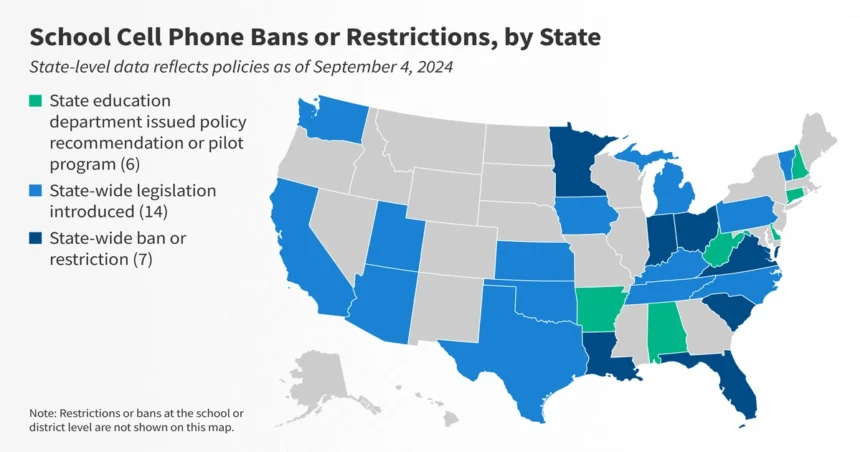
Maryland is not acting in isolation. Several states have moved in similar directions over the past two years, responding to mounting research linking heavy adolescent smartphone use to declining attention spans, increased anxiety, and weaker academic performance.
What sets Maryland’s approach apart is the statewide uniformity it demands. Rather than leaving the decision to individual districts, the law locks in a consistent standard across all 24 county school systems, from Baltimore City to rural Western Maryland.
How districts choose to enforce the policy, whether through phone pouches, locked storage, or other methods, will likely vary. That detail is still being worked out as school boards prepare for the 2026 implementation window.
Relevant posts
- Atholton Adventist Academy: A Closer Look at a Trusted Howard County School
- Atholton High School Shooting Threat: Knife Found, Lockdown Questions Remain
- Atholton High School Ranking: Where the Columbia School Stands in 2026
Visit atholtonnews.com for more stories.