


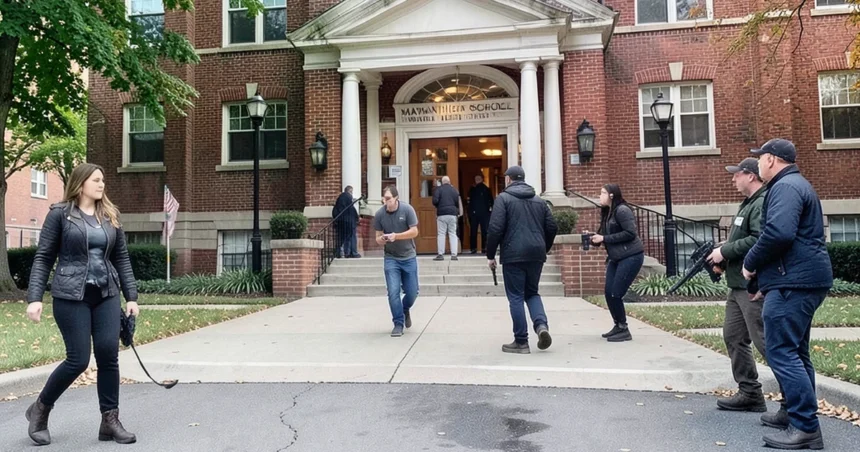
Matawan High School: The halls of Matawan Regional High School (MRHS) recently echoed with an unsettling silence, not for a fire drill, but for a real-world lockdown on March 9, 2026. This incident, reportedly involving an attempt by a former student to enter the building with a weapon, brought home the immediate challenges facing our educational institutions. While no one was harmed, the event underscored a critical juncture for the school and its community, demanding a closer look at what defines MRHS today and how it’s adapting to an evolving landscape.
- Matawan Regional High School is a public institution in Aberdeen, NJ, serving approximately 1,154 students in grades 9-12.
- The school district grapples with significant budget complexities, including state funding shifts and a rising student population, particularly in special education.
- MRHS offers a diverse range of academic and extracurricular programs, including specialized academies and alternative credit pathways, aiming to provide varied opportunities for student success.
What Defines Matawan Regional High Today?
Matawan Regional High School, nestled in Aberdeen, New Jersey, stands as the sole secondary school for the Matawan-Aberdeen Regional School District, educating around 1,154 students. Our analysis suggests it consistently ranks in the top half of New Jersey high schools, a position it has maintained for the better part of a decade. Students here pursue diverse academic paths, supported by a student-teacher ratio of about 12:1.
The school boasts specialized academies in areas like Business, STEM, Civic Leadership, Global Humanities, and Visual & Performing Arts, designed to offer targeted, in-depth learning experiences. For instance, the Business Academy provides practical experience through initiatives like the Husky Fan Shop, a student-run retail store, and offers college credits through a Supply Chain Management pathway with Rutgers Business School. These programs aim to prepare students not just for college, but for tangible career readiness. Moreover, the district actively promotes “Option II” pathways, allowing students to earn credits through alternative experiences like internships or early college courses, fostering personalized learning beyond traditional classroom settings.
However, the narrative isn’t uniformly positive across all metrics. While Niche.com rates MRHS as an “above average” public school and highlights its diversity, other data points offer a more nuanced picture. For example, some rankings place Matawan Regional High in the bottom 50% of New Jersey schools for overall test scores, specifically noting math proficiency rates below the state average. This disparity in perception and performance metrics means that while the school excels in many areas, there are clear targets for improvement, particularly in core academic subjects.
Navigating the Financial Headwinds: A District’s Struggle
The financial landscape for the Matawan-Aberdeen Regional School District is complex, marked by both state funding changes and increasing demands. We’ve observed that the district is grappling with a surge in student enrollment, which has grown from 3,720 students in 2015 to nearly 3,990, with projections indicating continued expansion. This growth presents significant challenges, especially within special education, where the student population has increased by 26% over the last decade, leading to high costs for out-of-district placements.
State funding adjustments have further complicated matters. While special education funding saw an increase of over $2.5 million due to revised enrollment-based calculations, equalization aid was reduced by approximately $3.7 million. The district’s classification as “under adequacy” due to changes in the funding formula allows for a 2% tax increase and a 5% incentive through a new tax program, yet the practical implications for taxpayers remain a concern.
Here’s a snapshot of the district’s budgetary components:
| Budget Category | Impact on District | Current Challenges |
|---|---|---|
| State Aid | Fluctuating, with equalization aid reductions. | Unpredictable revenue, impacting long-term planning. |
| Enrollment Growth | Increased student population, particularly in special education. | Strained resources, higher special education costs (up to $3.5M for out-of-district placements). |
| Staffing | Shortage of substitute teachers (58% fill rate for 4,600 absences). | Increased costs for substitute coverage, difficulty attracting high-level science/math teachers. |
| Facilities | Concerns about the condition of high school bathrooms and lack of art supplies. | Deferred maintenance, impacting student and staff morale. |
The district is actively exploring strategies to manage these costs, including potentially hiring substitutes directly at a higher rate rather than relying on contracted services. This indicates a proactive approach to a persistent problem, though the underlying financial pressures remain substantial. In practical terms, this means the district must continually balance fiscal responsibility with providing a high-quality education, a task made more challenging by external financial shifts.
Beyond the Classroom: Innovation and Student Life
Matawan Regional High School is not just about academics; it’s a vibrant hub of student activity and community engagement. The school offers a wide array of clubs and activities, fostering a well-rounded educational experience. Student organizations, like the SADD (Students Against Destructive Decisions) chapter, have taken on significant community projects, such as advocating for driver safety and working with local police to improve traffic flow around the school. This demonstrates a commitment to civic responsibility and practical problem-solving among the student body.
That sounds great on paper, but the reality for students can sometimes be different. Reviews suggest that while there are many options for electives, students often need to be proactive in starting new initiatives if they want to pursue something not already established. Moreover, some students have expressed concerns about the “overbearing” nature of certain school rules and the condition of facilities, specifically mentioning outdated and poorly maintained bathrooms. The translation for their day-to-day is that while opportunities exist, the environment could benefit from more direct investment in student comfort and operational flexibility.
What Does This Mean for the Community?
The challenges and successes of Matawan Regional High School directly impact the surrounding communities of Aberdeen Township and Matawan. The recent lockdown incident, while contained, serves as a stark reminder of the broader safety concerns facing schools nationwide. Our team observed that such events can deeply affect student and parent morale, leading to calls for enhanced security measures and mental health resources. [cite