


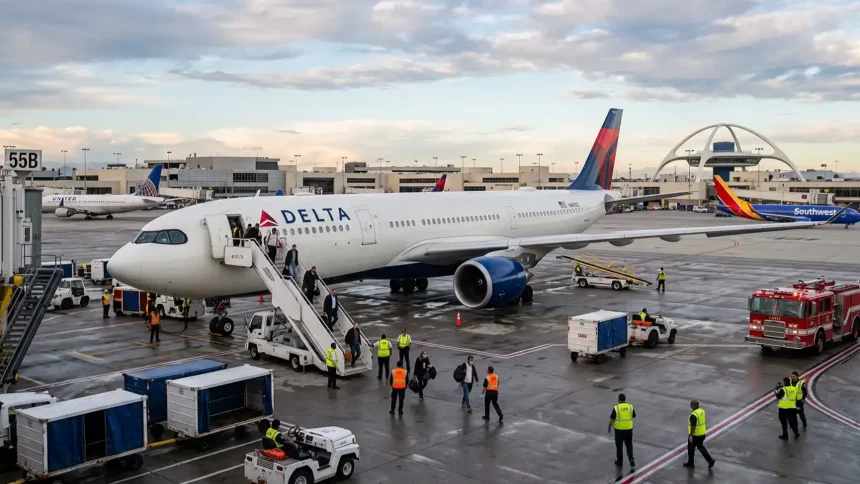
Delta Flight DL275 Diverted LAX became a widely discussed aviation incident during a routine trans-Pacific journey. Air travel is considered one of the safest forms of transportation in the world, with thousands of long-haul flights operating daily without problems. However, safety always remains the top priority in aviation. When a technical issue or unexpected situation occurs, pilots and airlines must act quickly to ensure the protection of passengers and crew.
Understanding Delta Flight DL275 Diverted LAX
Before diving into the incident, it is important to understand the flight route and aircraft involved.
Delta Flight DL275 Diverted LAX is a long-haul international service operated by Delta Air Lines, connecting the United States and Japan.
The flight typically operates between:
- Detroit Metropolitan Wayne County Airport (DTW) – United States
- Tokyo Haneda Airport (HND) – Japan
This route crosses the North Pacific Ocean and usually takes around 13 hours to complete.
The aircraft commonly used for this flight is the Airbus A350-900, a modern wide-body aircraft designed for long-distance international flights.
The aircraft is powered by Rolls‑Royce Trent XWB engines, known for efficiency and advanced safety technology.
What Happened: Delta Flight DL275 Diverted LAX
The incident occurred during a scheduled flight from Detroit to Tokyo.

Shortly after departure, everything appeared normal. The aircraft climbed to cruising altitude and began its journey across the Pacific Ocean.
However, while flying over the North Pacific, the flight crew detected a technical problem with the engine anti-ice system.
The aircraft was flying at around 38,000 feet, and the system responsible for preventing ice buildup in the engine showed signs of malfunction.
Delta Flight DL275 Diverted LAX
Because of this issue, the pilots decided that continuing the long trans-Pacific journey could increase risk. Instead, they made the safety-first decision to divert the flight.
The aircraft changed course and headed toward Los Angeles International Airport (LAX).
After several hours, the plane landed safely at LAX, and no passengers or crew members were injured.
This event became widely known online as Delta Flight DL275 Diverted LAX.
Quick Overview of the Incident
| Detail | Information |
| Flight Number | DL275 |
| Airline | Delta Air Lines |
| Aircraft | Airbus A350-900 |
| Route | Detroit → Tokyo |
| Diversion Airport | Los Angeles International Airport |
| Reason | Engine anti-ice system malfunction |
| Outcome | Safe landing, no injuries |
| Passenger Support | Rebooking and assistance |
Why the Engine Anti-Ice System Matters
To understand why Delta Flight DL275 Diverted LAX, we need to understand the role of the engine anti-ice system.
At high altitudes, temperatures can drop to -50°C or lower. Moisture in the air can freeze and form ice on aircraft surfaces and engines.
If ice builds up inside the engine, it can:
- Disrupt airflow
- Cause compressor stalls
- Reduce engine efficiency
- Damage internal components
The anti-ice system prevents this by heating critical engine areas.
Without this protection, continuing a long flight over cold oceanic regions becomes unsafe.
That is why the pilots made the decision to divert.
Delta Flight DL275 Diverted LAX
Why LAX Was Chosen for the Diversion
When the issue was detected, the crew had several possible diversion airports. However, Los Angeles International Airport was the best option.

There were several reasons for this.
1. Long Runways
Large aircraft like the Airbus A350 require long runways, especially when carrying large amounts of fuel.
LAX has multiple long runways capable of handling wide-body aircraft.
2. Airline Maintenance Facilities
Delta has strong operational support and maintenance teams at LAX, making it easier to inspect and repair the aircraft.
3. Emergency Services
Major international airports have advanced emergency response teams ready for aircraft incidents.
4. Passenger Support
Because LAX is a major global hub, passengers could easily be rebooked on alternative flights to Tokyo.
All these factors made LAX the safest and most practical diversion choice.
Timeline of the Incident
Here is a simplified timeline explaining how the situation unfolded.
| Time | Event |
| Departure | Flight DL275 takes off from Detroit |
| Cruise Phase | Aircraft climbs to cruising altitude |
| Technical Alert | Engine anti-ice system malfunction detected |
| Decision | Pilots decide to divert |
| Route Change | Aircraft turns toward Los Angeles |
| Landing | Safe landing at LAX |
| Aftermath | Passengers rebooked on new flights |
Passenger Experience During the Diversion
Passengers onboard initially noticed nothing unusual.
However, once the crew announced the diversion, many travelers became curious and slightly concerned.
According to reports, the crew remained calm and professional throughout the situation.
The captain explained that the diversion was a precautionary safety decision.
Passengers appreciated the transparency and the fact that the aircraft landed safely.
After landing at LAX:
- Passengers were assisted by airline staff
- Many were rebooked on alternate flights to Tokyo
- Some were provided meals and accommodation
This response helped minimize travel disruption.
Why Flight Diversions Are Common in Aviation
The phrase Delta Flight DL275 Diverted LAX might sound alarming, but diversions are actually a normal part of aviation safety.
Pilots are trained to divert flights whenever continuing the route could create unnecessary risk.
Common reasons for flight diversions include:
| Cause | Explanation |
| Mechanical Issues | Engine or system malfunction |
| Medical Emergencies | Passenger or crew health problems |
| Weather Conditions | Storms, turbulence, or poor visibility |
| Airport Congestion | Runway closures or heavy traffic |
| Security Concerns | Safety threats or suspicious activity |
In the case of Delta Flight DL275 Diverted LAX, the cause was purely technical and precautionary.
How Modern Aircraft Detect Problems Early
Modern aircraft like the Airbus A350 are equipped with advanced monitoring systems.
These systems constantly track:
- Engine temperature
- Pressure levels
- System performance
- Structural integrity
If a problem occurs, the system alerts the pilots and airline operations center.
This allows pilots to take action early, often before a small issue becomes a serious one.
The DL275 diversion is actually an example of these safety systems working exactly as intended.
Safety Procedures Followed by Pilots
Pilots follow strict international aviation protocols when an issue occurs.
The general process looks like this:
Step 1: Identify the Problem
Aircraft sensors detect abnormal readings.
Step 2: Assess the Situation
Pilots evaluate the severity of the issue.
Step 3: Contact Airline Operations
The crew communicates with the airline’s ground control and maintenance teams.
Step 4: Choose Diversion Airport
The safest airport within range is selected.
Step 5: Prepare for Landing
Air traffic control and emergency services are alerted.
In the case of Delta Flight DL275 Diverted LAX, this process worked smoothly.
Impact on the Aviation Industry
Incidents like Delta Flight DL275 Diverted LAX often attract public attention, but they also provide valuable learning opportunities for the aviation industry.
They help airlines improve:
- Predictive maintenance
- aircraft monitoring systems
- crew training programs
- passenger communication strategies
Experts often view such diversions as a success story for aviation safety, not a failure.
The aircraft landed safely, passengers were protected, and the system worked exactly as designed.
Delta Flight DL275 Diverted to LAX
What Travelers Can Learn From This Incident
For passengers, the Delta Flight DL275 Diverted LAX event highlights a few important points.
1. Diversions Are Safety Decisions
A diversion does not mean a disaster. It usually means the crew is taking precautionary action.
2. Modern Aircraft Are Highly Monitored
Advanced systems detect problems early.
3. Pilots Are Trained for These Situations
Flight crews train extensively for emergency and diversion scenarios.
4. Passenger Safety Is Always the Priority
Airlines will always choose safety over schedules.
Aviation Safety in 2026
Air travel continues to become safer each year thanks to:
- Advanced aircraft technology
- Predictive maintenance using AI
- Real-time aircraft monitoring
- improved pilot training
- global aviation regulations
Incidents like Delta Flight DL275 Diverted LAX demonstrate how well these systems work together.
Instead of allowing a technical issue to escalate, the pilots took action early and safely resolved the situation.
Conclusion
The story of Delta Flight DL275 Diverted LAX is not about a crisis—it is about how modern aviation safety works in practice.
During a routine trans-Pacific flight from Detroit to Tokyo, the aircraft experienced a malfunction in its engine anti-ice system. Rather than risk continuing the long journey over the ocean, the pilots chose the safest option: diverting the aircraft to Los Angeles International Airport.
For More Latest Updates Atholton News
