

The U.S. Department of Education has just supercharged the path to skilled careers with proposed new rules for federal student aid. As the public comment period opens, the forthcoming Workforce Pell eligible programs list 2026 is set to expand financial access for thousands seeking rapid job training, representing one of the most significant shifts in federal education funding in years.
→ Your Student Loan Repayment Is About to Change Dramatically
- Expanded Eligibility: Starting as early as July 2026, the new Workforce Pell Grant program will allow federal aid to cover short-term job training programs that are as brief as eight weeks long.
- New Rules Proposed: The Department of Education released its official Notice of Proposed Rulemaking (NPRM) in early March 2026, kicking off a 30-day public comment period that closes on April 8, 2026.
- Strict Accountability: To qualify, programs must be approved by state governors and meet rigorous federal standards for completion rates, job placement, and graduate earnings, ensuring a return on investment for students.
What Is the Big Change with Workforce Pell Grants?
For decades, Federal Pell Grants have been a cornerstone of college affordability, but they were almost exclusively limited to students in longer-term, degree-seeking programs. Our analysis of the new regulations shows this is about to change dramatically. The “Workforce Pell” expansion, born from the Working Families Tax Cuts Act, specifically targets the skills gap by funding shorter, more direct pathways to employment.
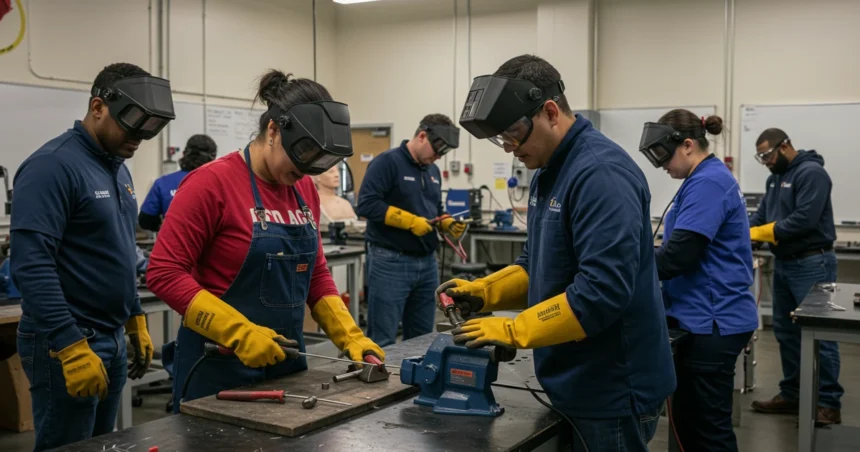
This policy shift means that for the first time, Pell Grants can be applied to non-degree, credential-focused programs that last between 8 and 15 weeks (or 150 to 599 clock hours). This opens up federal financial aid to a vast new category of training in high-demand fields like IT, healthcare, advanced manufacturing, and the skilled trades. The goal is to help students gain valuable credentials and enter the workforce quickly, with little to no debt.
How Do You Qualify for These New Grants?
From the student’s perspective, the process begins the same way: by filling out the Free Application for Federal Student Aid (FAFSA). Eligibility for the Workforce Pell Grant hinges on the same income-based requirements as the traditional Pell Grant.
However, there are some key differences. Our team observed that, unlike traditional Pell, students who have already earned a bachelor’s degree may still be eligible for a Workforce Pell Grant to pursue a new skill. It is important to note, however, that students cannot receive a traditional Pell Grant and a Workforce Pell Grant concurrently, and all aid received counts toward the student’s lifetime eligibility limit.
Key Eligibility Points for Students:
* Must meet standard Pell Grant income and eligibility requirements via the FAFSA.
* Must be enrolled in a program that has been approved and included on the state and federal lists.
* Unlike traditional Pell, students with a prior bachelor’s degree are not automatically disqualified.
What Programs Will Be on the Workforce Pell eligible programs list 2026?
The creation of the Workforce Pell eligible programs list 2026 is a multi-step process involving both state and federal oversight. It’s not a free-for-all for any short-term bootcamp. According to a press release from the U.S. Department of Education, programs must first be identified by the state’s governor, in consultation with the state workforce board, as aligning with a high-skill, high-wage, or in-demand occupation.
After a program receives state approval, the institution must apply to the Department of Education for final approval. Industry insiders are noting that while thousands of programs could theoretically fit the new time-based criteria, the stringent accountability measures mean the initial Workforce Pell eligible programs list 2026 will likely be much smaller and more curated. One early analysis in North Carolina suggested that only about 4% of the state’s current short-term programs would meet the high standards for job placement and completion. This meticulous approval process is designed to protect students and taxpayers.
What Are the New Accountability Rules for Schools?
Perhaps the most critical part of this expansion is the emphasis on results. To get on and stay on the Workforce Pell eligible programs list 2026, training providers must prove their value. According to the proposed rules, programs will be judged on strict metrics. As reported by outlets like POLITICO Pro, this is a major win for advocates of higher education accountability.
| Metric | Workforce Pell Requirement | Traditional Program Requirement |
|---|---|---|
| Program Length | 8-15 weeks (150-599 clock hours) | Typically 15+ weeks (600+ clock hours) |
| State Approval | Required by Governor & Workforce Board | Not required in this manner |
| Completion Rate | Must meet a minimum threshold (proposed at 70%) | Varies; not a direct Pell eligibility rule |
| Job Placement Rate | Must meet a minimum threshold (proposed at 70%) | Not a direct Pell eligibility rule |
| Graduate Earnings | Median earnings must exceed those of a typical high school graduate in the state | Not a direct Pell eligibility rule |
If a program fails to meet these benchmarks, it will lose its eligibility, preventing further federal funds from flowing to underperforming providers. This focus on outcomes is a defining feature of the Workforce Pell eligible programs list 2026.
What Obstacles Remain for the Workforce Pell Rollout?
While the program is slated to begin by July 1, 2026, our analysis suggests a challenging road ahead. State and federal agencies are on an aggressive timeline to finalize rules, establish approval processes, and build the necessary data infrastructure to track outcomes. Some officials have warned that it could realistically be 2027 before students can widely access these grants, as states work to identify eligible programs.
Organizations like New America have pointed out that successful implementation will require significant coordination between state higher education offices and workforce development boards, which have historically operated in separate silos. The public comment period, which ends April 8, 2026, offers a crucial opportunity for stakeholders—including colleges, employers, and the public—to weigh in on the proposed framework and help shape the final Workforce Pell eligible programs list 2026. This feedback is vital for refining the regulations.
Ultimately, the successful launch of this initiative will determine if it can truly become a powerful tool for economic mobility. The development of a robust Workforce Pell eligible programs list 2026 is the first major test. The continued refinement of the Workforce Pell eligible programs list 2026 will be essential for its long-term success in connecting Americans to quality jobs.
Relevant posts
- Golden State Valkyries vs New York Liberty Timeline
- Denver Nuggets vs OKC Thunder Match Player Stats: Top Players Who Stole the Spotlight
- Pittsburgh Steelers vs Bengals Match Player Stats: Who Stole the Show?
Visit atholtonnews.com for more stories.