
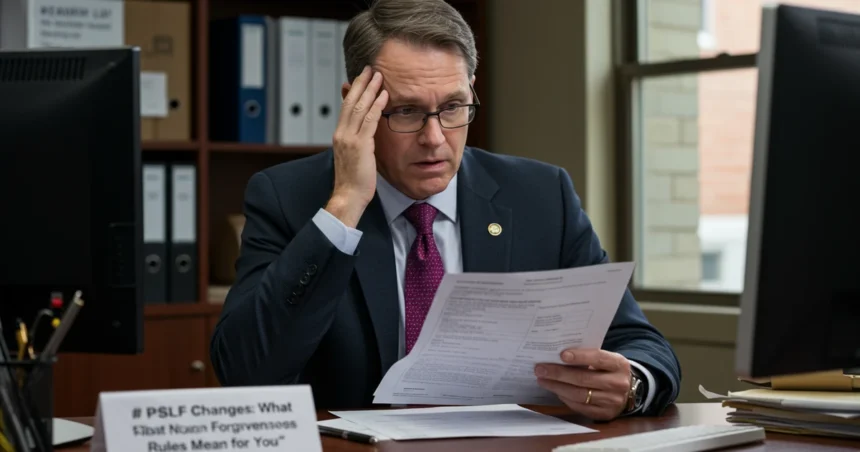
Recent education department calculation changes make public service loan forgiveness harder for borrowers, sparking confusion and concern among millions. Our team has been tracking the developments following the termination of the SAVE (Saving on a Valuable Education) plan and new rules set to take effect, altering the path to debt freedom for many public servants.
→ Remote Online Moderator Paid Training Jobs: Start Your Work-From-Home Career
The core of the issue stems from the elimination of the SAVE plan, which offered lower monthly payments based on a smaller percentage of discretionary income. Now, with its termination following a federal court ruling, the calculation for the Public Service Loan Forgiveness (PSLF) “buyback” option has been significantly altered. This shift is a primary reason why education department calculation changes make public service loan forgiveness harder for borrowers.
→ Kimmel: Melania’s Statement Reveals Deep White House Rift
This buyback option was a lifeline for those who had periods of forbearance or deferment, allowing them to retroactively make payments to qualify for the 120-month requirement for loan forgiveness. Previously, these buyback amounts were based on the more affordable SAVE plan formula. The new guidance, however, shifts to other income-driven repayment (IDR) plans, which could lead to substantially higher costs for borrowers.
Key Takeaways
- The termination of the SAVE repayment plan has led to changes in how PSLF “buyback” payments are calculated.
- Borrowers may now face significantly higher costs to buy back months of forbearance or deferment, as calculations will rely on more expensive IDR plans instead of the former SAVE plan.
- New rules taking effect on July 1, 2026, will also change which employers qualify for PSLF, potentially disqualifying some nonprofit organizations.
The “Buyback” Dilemma: A Closer Look
The education department calculation changes make public service loan forgiveness harder for borrowers by directly impacting the affordability of the buyback program. For example, a borrower who could have paid a lump sum based on their low SAVE plan payment to reach their 120-payment goal might now face a bill that is several times higher under a different IDR plan like IBR (Income-Based Repayment).
This change affects a significant number of people; as of February 28, 2026, there were 88,170 pending PSLF buyback applications. For these individuals, the path to forgiveness has suddenly become much more expensive. This is a critical factor in why education department calculation changes make public service loan forgiveness harder for borrowers.
The Department of Education has stated that for buyback calculations on or after July 1, 2024, if a borrower was not on an IBR, PAYE, or ICR plan, their income and family size information will be requested to determine the new buyback amount. This adds another layer of complexity to a process that was already seen as difficult to navigate. This is another reason the education department calculation changes make public service loan forgiveness harder for borrowers.
Expert Q&A
Our team sought clarity on these new developments. Here’s what we found:
Q: What is the most significant immediate change for borrowers pursuing PSLF?
A: The most immediate and impactful change is the recalculation of the “buyback” option. Borrowers who were counting on using the lower payment formula from the now-defunct SAVE plan will likely see their buyback costs increase substantially, as they will now be calculated based on other, potentially more expensive, income-driven repayment plans.
Q: How are new borrowers or those changing plans affected by the elimination of the SAVE plan?
A: With the SAVE plan gone, borrowers have to choose from remaining IDR plans like IBR, PAYE, and ICR, though some of these are being phased out. A new Repayment Assistance Plan (RAP) is set to roll out, but borrowers who take out new loans after July 1, 2026, will only have access to IBR and RAP, limiting their options.
A Shifting Landscape for Qualifying Employment
Adding to the financial pressure, upcoming regulations effective July 1, 2026, will alter the definition of a “qualifying employer” for PSLF. This has raised alarms among nonprofit organizations and their employees, who fear they may be disqualified based on new, politically influenced criteria. These education department calculation changes make public service loan forgiveness harder for borrowers by creating uncertainty around their long-term eligibility.
The new rules could exclude employers deemed to be involved in “illegal activities,” a term that advocates worry could be interpreted broadly to exclude organizations that don’t align with the administration’s political agenda. This potential narrowing of eligible employers further complicates the landscape for public service workers counting on loan forgiveness. The anxiety this creates is a key part of why the education department calculation changes make public service loan forgiveness harder for borrowers.
The combination of more expensive buybacks and uncertain employer eligibility has left many public servants in a difficult position. As discussed on forums like Reddit’s r/PSLF, borrowers are expressing significant stress and confusion over these developments. Many now face the tough choice of paying a much higher amount to achieve forgiveness or abandoning the PSLF path they have been on for years. This is the reality of how the education department calculation changes make public service loan forgiveness harder for borrowers.
For more information, borrowers can refer to guidance from the Department of Education and resources from organizations like the National Consumer Law Center.
Relevant posts
- Sonic’s 2026 Takeover Is Just Beginning
- Clinical Research Coordinator Job 2026: Child and Adolescent Psychiatry Role at Johns Hopkins University
- New England Patriots vs Baltimore Ravens Match Player Stats
Visit atholtonnews.com for more stories.