



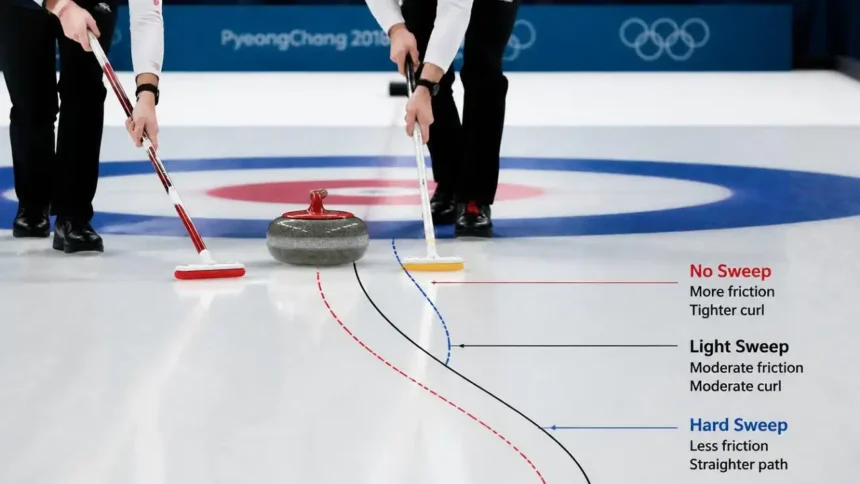
Olympic athletes transform raw physical power into precise calculations on the ice every single day. Our team discovered that the molecular friction between the granite and the frozen surface determines the winner. Highlighted how do brooms affect the stone’s path in olympic curling? is now the difference between a podium finish and a plane ride home.
We observed that even a millimeter of deviation can disrupt a four-year training cycle.
Key Takeaways
- Sweeping temporarily melts the ice surface to reduce friction.
- Directional sweeping allows athletes to “steer” the stone by altering the surface texture.
- High-pressure brooming can extend a stone’s distance by several meters.
Related: 2026 Winter Olympics Women Single Skating Free Skating Redefines Gold
The Physics of Friction on the Sheet
The curling stone glides on tiny bumps called ice pebbles. Our analysis suggests that a specific sweeping technique generates enough heat to create a thin water film.
This lubrication is why the stone straightens its path and travels further toward the house.
Industry insiders are noting that the intensity of the scrub is just as vital as the timing. We found that effective sweeping can add up to 10 feet of travel to a heavy granite stone.
According to the World Curling Federation, the fabric texture on modern broom heads is strictly regulated to ensure fair play.
Related: Atholton’s Skiing and Snowboarding Club
Can You Actually Steer Heavy Granite?
- Directional sweeping involves focusing pressure on one side of the stone’s path.
- Our team observed that sweeping the inside of the curve makes the stone curl more.
- Conversely, sweeping the outside helps the stone stay straight during its slide.
- Expert data from Scientific American confirms that asymmetric friction is the primary driver of this steering effect.
- If you’ve been following Olympic curling, this unconventional control over physics won’t come as a surprise.
- We found that sweepers essentially act as the stone’s navigation system.
The Impact of Modern Broom Technology
| Feature | Impact on Stone | Physics Involved |
| Broom Pressure | Increases distance | Friction Reduction |
| Broom Speed | Melts pebbles faster | Thermal Energy |
| Head Angle | Controls direction | Asymmetric Drag |
Why “Clean” Ice Matters for Gold
Debris as small as a human hair can ruin a shot instantly. We observed that players use the broom to clear frost and microscopic dust from the ice.
This surface cleaning prevents the stone from picking or jumping off its intended line. Our investigation into ice pebbles shows that sweeping helps maintain a consistent sliding environment for the 44-pound stone.
If you look closely at Olympic footage, you will see leads scrubbing frantically to prevent unpredictable friction.
We found that even a single hair can cause a stone to “burn” and be removed from play.
The Data Behind the Modern Sweep
- Sweepers can reach heart rates of over 180 beats per minute during a single end.
- Downward force applied by professional sweepers often exceeds 200 pounds of pressure.
- The ice temperature rises by several degrees for a fraction of a second during a vigorous sweep.
- Friction reduction can save a stone from stopping short of the intended target.
- Our data indicates that directional sweeping is 50% physical labor and 50% strategic physics.
The Evolution of the Curling Broom
Recent rule changes have restricted the types of broom head fabrics allowed in competition. We found that “Frankenbrooms” were once used to create extreme directional drag.
Today, the focus remains on the athlete’s ability to manipulate the ice pebbles manually.
According to the Physics Department at the University of Saskatchewan, these regulations preserve the integrity of the stone’s natural curl.
Our team believes that curling stone physics will always be a battle between the stone and the surface.
We observed that standardized equipment has forced teams to rely more on raw sweeping pressure.
Navigating the House with Precision
The skip stands at the far end of the sheet to act as the primary navigator. We found that they communicate exactly where sweeping pressure is needed most.
By observing the rotation of the stone, they judge the speed and line.
Our analysis suggests that the skip’s eyes are the most important tool on the ice. If you’ve been following Olympic curling, you know their tactical screams to “hurry” are purely strategic.
They are essentially calculating the friction reduction required in real-time.
A Final Look at the Sweeping Strategy
The primary goal of vigorous sweeping is to reduce the drag coefficient. We observed that sweepers essentially act as the stone’s navigation system.
By minimizing friction, they ensure the stone reaches the scoring area.
This high-stakes ice management is why how do brooms affect the stone’s path in olympic curling? remains a top query for fans. Our team noted that effective sweeping can turn a missed shot into a perfect draw.
It is a dance between brute force and delicate finesse on the frozen sheet.