



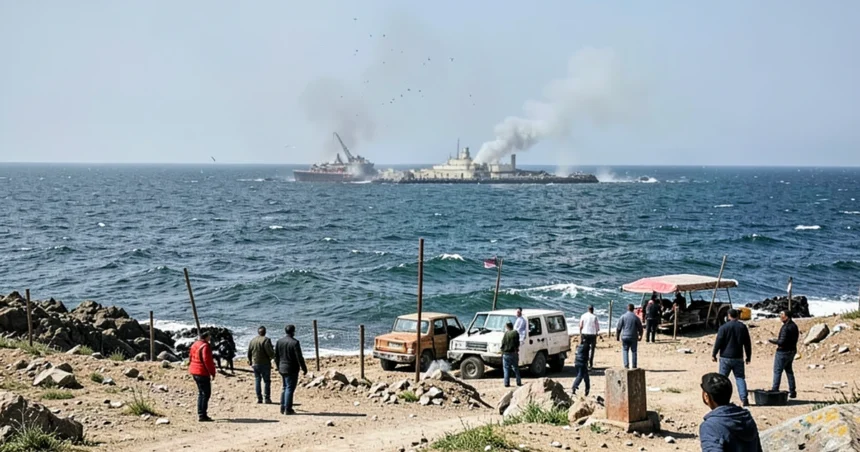
The United States has attacked Iran’s most critical economic asset, Kharg Island.
→ Rivalry’s New Chapter: Why Today’s Hoops Game Matters.
But the real story isn’t what was hit—it’s what was deliberately left standing.
Our team sees this as a dramatic escalation in the two-week-old conflict, a high-stakes warning shot that puts the entire global oil supply on notice.
- The Event: U.S. forces, at the direction of President Donald Trump, executed bombing raids on Kharg Island, the hub for nearly 90% of Iran’s oil exports.
- The Target: The strikes “totally obliterated” military installations but intentionally avoided the island’s vital oil infrastructure.
- The Threat: President Trump linked the attack to Iran’s recent blockade of the Strait of Hormuz, warning that the island’s oil facilities could be next if interference with global shipping continues.
What Exactly Happened on Kharg Island?
In a series of posts on his Truth Social platform, President Donald Trump announced that U.S.
→ Atholton vs Wheaton Softball Game 2026
Central Command had carried out “one of the most powerful bombing raids in the history of the Middle East.” The targets were exclusively military.
Think naval mine storage facilities, missile bunkers, and airport runways.
Iranian state media has, for its part, confirmed that oil facilities were not damaged in the attack.
This wasn’t a random act.
It’s a direct response to escalating tensions that have seen Iran effectively close the Strait of Hormuz, a chokepoint for a massive portion of the world’s oil.
The message from Washington is brutally clear: we can turn off your entire economy whenever we choose.
It’s that simple.
The Island That Is Iran’s Economic Aorta
To understand the gravity of this strike, you have to understand Kharg Island.
It is not just another piece of land.
This small coral outcrop, about a third of the size of Manhattan, is the economic aorta of the Iranian state.
Roughly 90% of all of Iran’s crude oil exports flow through its terminals.
Pipelines from the country’s biggest oilfields converge here, loading supertankers bound for international markets.
On an average day, between 1.3 and 1.6 million barrels of oil leave this island.
For more discussion, see this discussion on Reddit.
It has long been considered Iran‘s “crown jewel” and, conversely, its greatest strategic vulnerability.
The island was repeatedly targeted during the Iran-Iraq War in the 1980s for this very reason.
According to analysis from investment bank JP Morgan, a direct strike that halts exports would likely trigger severe retaliation and have serious economic consequences.
A Calculated Warning Shot
This was not an attempt to cripple Iran.
Not yet.
By striking military assets while publicly declaring the oil infrastructure was spared “for reasons of decency,” the U.S. has fired a warning shot.
The translation for your day-to-day is that this was designed to avoid an immediate, catastrophic spike in gas prices, which experts have warned could shoot past $150 a barrel if Kharg’s oil terminals go offline, as noted by analysts at Chatham House.
The move is a classic piece of coercive diplomacy.
It demonstrates overwhelming capability without pulling the final trigger.
President Trump explicitly tied the decision to Iran‘s behavior in the Strait of Hormuz.
The implication is that the safety of Kharg’s oil jetties is now conditional on the free passage of tankers through the Gulf.
This escalation is being backed by significant military movements.
The Pentagon is deploying the USS Tripoli amphibious assault ship along with 2,500 Marines to the region, a major addition of forces that could arrive within weeks.
While conventional wisdom says this is a prelude to destroying Iran’s oil exports, our data points to a different reality: This is about demonstrating overwhelming power to force a strategic choice, all while trying to manage the blowback on global energy markets.
Striking the military targets was a way to escalate without causing an immediate oil price catastrophe.
A full strike on the oil terminals would take the bulk of Iran’s crude offline instantly, sending markets into a “tailspin,” as one report in The Guardian noted before the attack.
This measured approach leaves room for de-escalation, however narrow that path may be.
The Impact on Global Energy
Even a limited strike has sent ripples through the energy sector.
Markets are now pricing in a much higher risk of disruption.
The attack proves that a key piece of global energy infrastructure, previously considered too vital to touch, is now in play.
As one analyst from GasBuddy told The Straits Times, “I’m very concerned it elevates the temperature and Iran has less to lose and it seems to escalate.” Iran has already threatened to retaliate against U.S.-linked energy infrastructure in the region.
Here’s what’s at stake:
| Kharg Island Metrics | Volume / Capacity | Global Significance |
|---|---|---|
| Daily Export Volume (Avg) | 1.3 – 1.6 Million Barrels | Represents approx.
90% of Iran’s total oil exports. |
| Recent Export Surge (Mid-Feb) | Over 3 Million Barrels/Day | Iran attempted to move as much crude as possible before anticipated military action. |
| On-Island Storage Capacity | ~18 – 30 Million Barrels | A strategic reserve that can keep exports flowing for days if pipelines are cut. |
The Human Reaction and Hidden Costs
This conflict is not happening in a vacuum.
On social media, discussions are rampant, with platforms like Reddit hosting threads where users analyze satellite imagery and debate the strategic implications.
The war has already led to casualties across the region, including in Lebanon and Iraq.
In a sign of the widening information war, police in Abu Dhabi arrested 45 people for “spreading misinformation” by filming and sharing locations related to the conflict.
But let’s step back for a second.
There is another, quieter crisis unfolding.
An Iranian environmental official has warned that the escalating military conflict poses a severe threat to the fragile marine ecosystems of the Persian Gulf.
Explosions and potential spills from damaged vessels risk releasing a cocktail of oil, toxic chemicals, and other hazardous materials into these sensitive waters.
This is the frustrating reality of modern conflict; the environmental damage is a silent casualty that could last for decades, long after the fighting stops.
Relevant posts
- Why Bellamkonda’s Sudden Rise Will Reshape Ohio State
- The Real Reason Anna Lake Invasive Species are Trending
- Texas Roadhouse Employee Kevin Wells Farewell
Visit atholtonnews.com for more stories.