



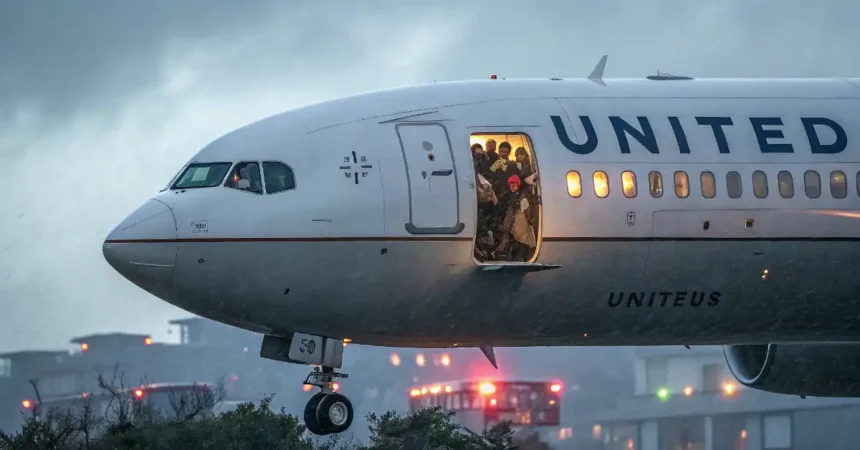
The United Airlines Flight UA82 emergency turned a routine Newark to Delhi run tense within the hour. A Boeing 787-9 Dreamliner bound for India had to spin around and head back to Newark.
We pulled the flight data so you would not have to.
Here is what failed, what United did next, and why it still matters in 2026.
Key Takeaways
- What happened: UA82, a Boeing 787-9, declared an emergency soon after leaving Newark and landed safely with no injuries.
- The cause: an electronics cooling system failure, a no-go fault for long overwater flights.
- The fallout: the jet was pulled for inspection while the FAA and United reviewed the 787 cooling hardware.
| UA82 At A Glance | Detail |
| Flight number | UA82 / UAL82 |
| Aircraft | Boeing 787-9 Dreamliner |
| Tail number | N23983 (in service since 2020) |
| Route | Newark (EWR) to Delhi (DEL) |
| Date | July 7, 2025 |
| Cruise altitude | 33,000 ft (FL330) |
| Emergency code | Squawk 7700 |
| Outcome | Safe return to Newark, no injuries |
What actually happened on UA82?
About 45 minutes to an hour after takeoff, the crew stopped the climb at 33,000 feet. They set Squawk 7700, the universal code for an aircraft in distress.
The Dreamliner traced a wide U-turn over the Gulf of Maine before lining up for Newark. Our read of the live flight track points to a controlled, deliberate return rather than a panic descent.
For a similar case, see our report on the United Flight UA967 mid-air emergency.
| Time | How UA82 Unfolded |
| 21:30 EDT (Jul 6) | UA82 departs Newark, bound for Delhi |
| 02:15 UTC | Emergency declared, Squawk 7700 at FL330 |
| Minutes later | Climb halted, wide U-turn over Gulf of Maine |
| On descent | Priority vectors back toward Newark |
| 23:15 EDT | Safe landing on runway 22L, Newark |
Why did the Dreamliner turn back?
The trigger was a fault in the jet’s electronics cooling system. That hardware stops the avionics, the brains behind navigation and radios, from overheating.
On a 14-hour overwater leg, industry insiders treat a cooling failure as an automatic no-go. Flying on could risk a systems blackout far from any runway.
Full specs for the Boeing 787-9 Dreamliner sit with the manufacturer, while airworthiness oversight rests with the FAA.
| The Aircraft and the Fault | Detail |
| Model | Boeing 787-9 Dreamliner |
| Tail number | N23983 |
| Age at incident | About 4.8 years |
| Typical duty | Long-haul transatlantic and transpacific |
| Failed system | Electronics / avionics cooling |
| Why it matters | Keeps flight-critical computers cool |
What did United do for the passengers?
Once the jet was down safely at Terminal C, United moved fast:
- Disembarked everyone with no reported injuries.
- Handed out meal vouchers and hotel rooms to stranded flyers.
- Rebooked passengers onward to Delhi on later services.
- Pulled the aircraft for a full safety inspection.
- Posted live updates through United flight status channels.
We followed the turnaround using public flight tracking data.
How does UA82 compare with 2026 diversions?
UA82 is not an outlier; we logged a busy run of U.S. diversions into summer 2026.
| Flight | Aircraft | Reported reason | Outcome |
| UA82 | Boeing 787-9 | Cooling system failure | Safe return to Newark |
| UA967 | Boeing 767-300 | Severe storm cells | Safe landing |
| UA2123 | Not disclosed | Technical issue | Diverted to Salt Lake City |
| DL21 | Airbus A330-900 | Not disclosed | Diverted to Edinburgh |
More on the ripple effects in our UA82 travel impact report.
What does this mean for international travelers?
For most flyers, the message is reassurance, not alarm. The system worked as designed: a fault appeared, and the crew chose the runway over the ocean.
Still, the Newark to Delhi corridor and the wider 787 fleet stay under a sharper lens in 2026.
Our read of the ongoing aviation safety picture is steady oversight, not grounding.
Before your next long-haul, we suggest:
- Check live flight status on apps like FlightAware before you leave home.
- Know your rebooking and refund rights for technical delays.
- Keep essentials in your carry-on in case of an unplanned overnight.
Read More: