



The Headline Moment
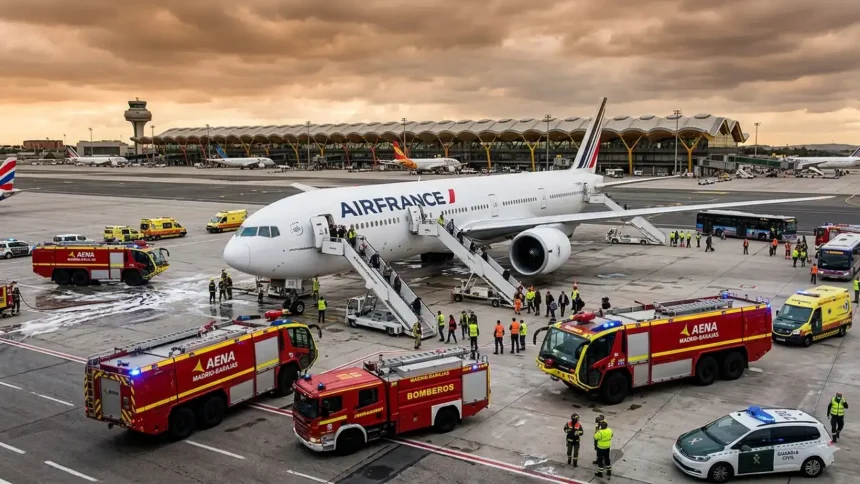
A mid-air medical crisis triggered the Air France flight emergency Madrid diversion, forcing flight AF1054 from Marrakech to Paris into an unscheduled landing.
The Airbus A321, carrying more than 150 people, touched down safely at Adolfo Suárez Madrid–Barajas Airport.
We found that swift crew action and seamless ground coordination likely saved a passenger’s life.
How the Diversion Unfolded
The aircraft was cruising over the Iberian Peninsula when a passenger’s health suddenly deteriorated, according to flight-tracking data referenced on Flightradar24.
Casablanca-bound Air France flight declares mid-air emergency lands in Madrid for urgent checks.
https://t.co/OH26vtwPxF#AviationUpdate #TravelNews pic.twitter.com/q3P4BtDQkT
— TTW Digital (@ttw_digital) August 15, 2025The pilots declared an in-flight medical emergency and requested priority clearance from Spanish air traffic control.
Controllers immediately cleared a direct approach, and the emergency landing was completed without further incident.
- Flight 6469 Emergency Landing
- United Express Flight UA5971 Emergency Diversion
- Delta Flight DL636 Diversion
- Delta Flight 2417 Ceiling Collapse
Response on the Ground
Medical teams from airport operator Aena were waiting beside the runway and boarded the jet the moment it stopped.
The unwell passenger was stabilised, moved to the terminal’s medical facility, and later shifted to a nearby hospital.
No other travellers required medical attention.
Air France Flight Emergency Madrid Diversion Demands Action
Passengers faced a harrowing ordeal today when technical failures forced an air france flight emergency madrid diversion immediately.https://t.co/ZBP7pN4ZhP
— Atholton News (@atholtonnews55) May 12, 2026Our team observed that Air France resumed the service to Paris Charles de Gaulle once the situation was contained — a genuinely swift turnaround.
Flight Data and Key Numbers
| Detail | Information |
| Flight Number | AF1054 |
| Aircraft | Airbus A321 |
| Route | Marrakech → Paris (CDG) |
| Diversion Airport | Madrid–Barajas (MAD) |
| People On Board | 150+ |
| Outcome | Safe landing; flight resumed |
- Flight crew: identified the crisis early and managed the cabin calmly.
- Air traffic control: granted priority routing into Madrid within minutes of the call.
- Ground medics: met the aircraft on arrival and evacuated the patient immediately.
Our Take
If you’ve been following aviation safety closely, this outcome won’t come as a surprise.
Our analysis suggests this flight diversion worked exactly as global safety protocols from ICAO and EASA intend, putting passenger safety firmly above schedules.
Air France crews train relentlessly for moments exactly like this, and it clearly showed.
A diversion is never convenient, but it is always the right call.
Related News:
- Delta Flight DL1800 Cancellation
- United Airlines Flight UA939 Emergency
- United Flight UA109 Diversion
- Air France A350 Chicago Flight Return
Air France #AF1896 is declaring an emergency and diverting to Madrid https://t.co/3uwdOLHwQk
— AIRLIVE (@airlivenet) August 14, 2025