



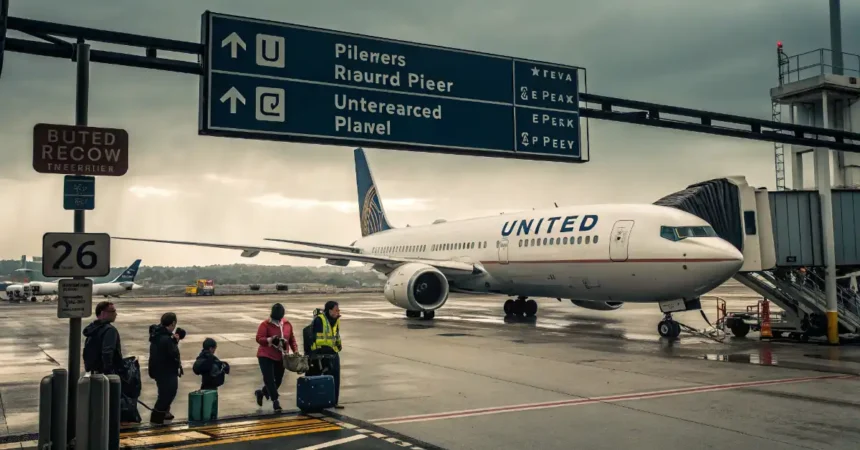
A routine Munich to Washington flight made a sudden U-turn over the ocean, and the United Flight UA109 Diversion has been circulating online ever since.
We checked the flight records and the earliest reports.
The short version: it was real, it was minor, and a single crew medical issue, not the aircraft, sent the jet to Dublin.
KEY TAKEAWAYS
- On 30 October 2025, United’s Boeing 787-8 Dreamliner (reg N28912) diverted from Munich (MUC) toward Washington Dulles (IAD) and landed at Dublin after a cabin crew medical issue.
- There was no mechanical fault, weather, or security threat, and all roughly 200 passengers reached Washington the same day.
- The total delay was about two hours, and the route returned to normal operations immediately.
What actually happened on UA109?
UA109 left Munich at 9:00 AM local time, bound for Washington Dulles. About 90 minutes in, roughly 500 to 600 nautical miles west of Ireland, a flight attendant’s condition worsened.
Reports point to severe pain from a blister, which left the cabin below the minimum crew required to keep flying.
The captain turned back, and the Boeing 787-8 landed safely at Dublin Airport around 3:00 PM GMT.
| Detail | Confirmed information |
| Flight | United Airlines UA109 |
| Aircraft | Boeing 787-8 Dreamliner (reg N28912) |
| Route | Munich (MUC) to Washington Dulles (IAD) |
| Date | 30 October 2025 |
| Diverted to | Dublin Airport (DUB) |
| Cause | Cabin crew medical issue (reported blister) |
| On board | About 200 passengers, no injuries |
| Total delay | About two hours |
How did the timeline unfold?
Here is the sequence, by the clock, matching the path logged on trackers such as FlightAware.
| Time (as reported) | Event |
| 9:00 AM CET | UA109 departs Munich for Washington Dulles |
| About 90 minutes in | Crew medical issue reported over the North Atlantic |
| Mid-Atlantic | Captain authorises the diversion and the jet turns back |
| About 3:00 PM GMT | Lands safely at Dublin (DUB) |
| 4:15 PM GMT | Departs Dublin after medical checks and refuelling |
| 6:30 PM ET | Arrives Washington Dulles, about two hours late |
Why divert to Dublin and not Boston?
Our analysis lines up with the flight data, and the answer is straightforward.
- Location: Dublin sits beside the busy North Atlantic corridors that transatlantic flights already use.
- Capability: the runways and gates at Dublin Airport handle widebody jets like the 787 with no trouble.
- Medical support: trained emergency teams and hospitals are only minutes away.
- Rules: under ETOPS planning, crews pre-select alternates exactly like this one.
Was this a safety failure?
No, and the reason matters. Cabin crew are safety workers first, trained for evacuations and onboard emergencies.
When the number of fit crew drops below the legal minimum, the flight cannot continue, even when the aircraft is perfectly sound.
Under FAA and EASA crew rules, diverting was the by-the-book call, not a red flag.
Confirmed facts vs. online rumors
Plenty of recycled posts got the details wrong, so we sorted fact from noise.
| What spread online | What the record shows |
| “Diverted to Boston” | False. Dublin was the diversion point from the turn. |
| “Engine or mechanical failure” | False. The 787-8 stayed fully operational. |
| “Security or passenger emergency” | False. The trigger was a crew medical issue. |
| “Crew member hospitalised” | Not supported. Reports indicate no hospitalisation. |
| “About a two-hour delay” | Confirmed by same-day trade reporting. |
How does this compare with other 2026 diversion stories?
If you have followed our coverage, this pattern of viral, recycled flight stories will look familiar.
We saw the same questions around the United Flight UA770 emergency diversion and the more recent United Flight UA967 diversion.
The Delta Flight DL275 diversion at LAX raised the same doubts about what was actually confirmed.
What does this mean for travelers?
If your own flight ever diverts, here is what we tell readers.
- Expect short delays, since most medical diversions clear within two to three hours.
- Keep your boarding pass handy for quick rebooking if a connection slips.
- A sharp turn on a tracker app looks dramatic, yet it rarely signals real danger.
- Follow crew instructions, because the diversion exists to protect you.
Bottom line: the United Flight UA109 Diversion was a calm, rules-driven detour with a safe ending.
We will update this report if United or aviation regulators release anything new.
Read More: