



Maryland Falls to 20th in Education Despite Historic Funding Boost
→ Maryland Enacts Statewide Bell-to-Bell Cell Phone Ban in All Public Schools
Maryland’s public schools are slipping in national rankings even as the state pours billions of dollars into education, raising uncomfortable questions about whether the money is actually reaching students where it counts.
→ Maryland Joins 14-State Lawsuit to Block Federal Cuts to School Mental Health Grants
The Annie E. Casey Foundation’s annual Kids Count Data Book, released earlier this month, ranks states on child well-being across several categories, including education. Maryland’s education ranking has dropped significantly over the past decade, falling to 20th in the country. The foundation, which is based in Baltimore, measures educational performance using pre-school attendance, public school math and reading proficiency rates, and high school graduation rates.
A decade of decline
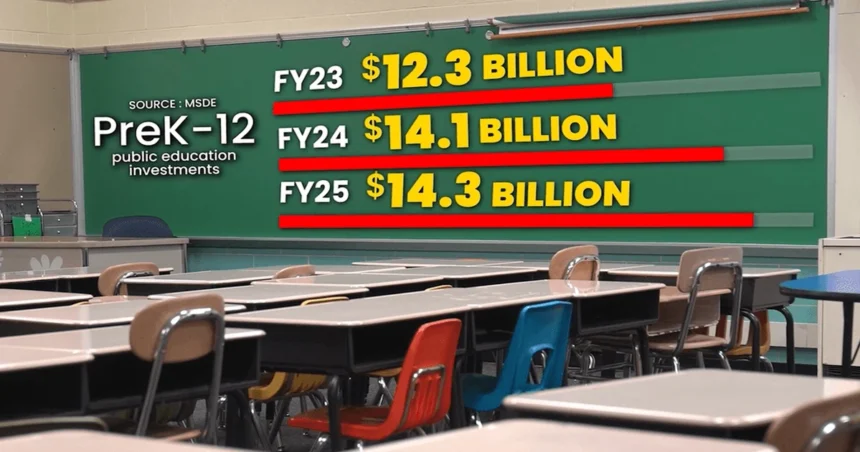
In 2016, Maryland sat near the top of the national education rankings. The state has since lost ground steadily, even as Annapolis approved historic levels of school funding. That includes money tied to the Blueprint for Maryland’s Future, a sweeping education reform law that was projected to funnel billions of dollars into public schools over a decade, with a particular focus on low-income communities and underperforming districts.
Governor Wes Moore signed the Fiscal Year 2027 state budget into law this year, which he described as delivering historic education investments without raising taxes or fees. The budget maintains the state’s Rainy Day Fund at 8 percent and increases the general fund balance to $250 million, with education and public safety listed as the central priorities.
The pushback from Annapolis
Not everyone accepts the report’s conclusions at face value. Dr. Joshua Michael, President of the Maryland State Board of Education, acknowledged the drop but argued the Kids Count Data Book offers a narrow view of the state’s overall education system.
“It is not a comprehensive look at our education system. It’s a dipstick,” Michael said, adding that he was still surprised to see the ranking fall.
His pushback reflects a broader tension in Annapolis between officials who believe the Blueprint investments need more time to show results and critics who say the data speaks clearly enough on its own.
What the numbers mean for families
Maryland State Delegate Kathy Szeliga, a former Baltimore City teacher, was less measured in her reaction. “The results are abysmal,” she said. “Instead of Maryland achieving more, we’re actually declining.”
For parents and students, the ranking matters because it reflects real outcomes, not just spending commitments. Math and reading proficiency rates in Maryland’s public schools remain well below where state leaders had hoped they would be by now, and the gap between the state’s wealthiest and lowest-income districts continues to draw attention.
The central tension here is straightforward: Maryland is spending more on education than at almost any point in its history, yet fewer students are performing at grade level compared to peers in other states. Whether that reflects a flaw in how the money is being spent, a lag before long-term reforms take hold, or something else entirely is a question state leaders have not yet answered convincingly.
Relevant posts
- California DMV License Test Irregularities: 11,000 Drivers Retake
- Atholton Adventist Academy: A Closer Look at a Trusted Howard County School
- Atholton High School Shooting Threat: Knife Found, Lockdown Questions Remain
Visit atholtonnews.com for more stories.