



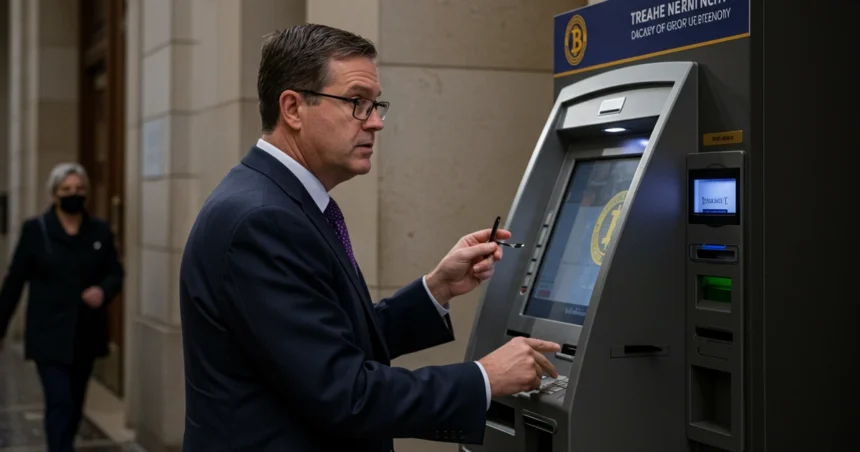
Washington D.C. – Federal authorities are sounding the alarm over the illicit use of the common bitcoin atm, citing a dramatic spike in fraud and money laundering schemes. A recent advisory from the Treasury Department’s Financial Crimes Enforcement Network (FinCEN) urges financial institutions to increase vigilance, as criminals increasingly exploit these kiosks for illegal activities, including laundering drug proceeds and orchestrating scams that target the elderly.
→ LeBron James Future Uncertain: Injury Mars Playoff Exit
The FinCEN notice highlights a disturbing trend where convertible virtual currency (CVC) kiosks are used as an alternative to traditional bulk cash smuggling by criminal organizations. This warning comes as data from the FBI’s Internet Crime Complaint Center (IC3) reveals a staggering 99% increase in complaints related to crypto ATMs in 2024, with reported victim losses hitting approximately $246.7 million. These schemes often involve scammers directing victims to deposit cash into a bitcoin atm under false pretenses.
→ Air France Flight Emergency Madrid Diversion Demands Action
Our team has observed that regulatory scrutiny is intensifying across the country in response. At least 20 states are now considering or have already adopted new laws to curb the abuse of these machines, a clear signal that the era of lax oversight may be ending. For instance, Colorado enacted a law requiring fraud warnings and setting daily transaction limits on any bitcoin atm.
“While CVC kiosks can be a simple and convenient way for consumers to access CVC, scammers and other illicit actors can also exploit their simplicity and convenience,” FinCEN stated in its recent advisory notice.
The Mechanics of a Bitcoin ATM Scam
For more discussion, see this discussion on Reddit.
Understanding how these scams operate is key to avoiding them. The process is often ruthlessly efficient and preys on a victim’s fear and lack of technical knowledge.
-
The Hook: Scammers initiate contact, often by phone, posing as government agents (from the IRS or FBI), tech support from major companies, or even a victim’s own bank. They create a sense of extreme urgency, claiming the victim’s accounts are compromised or that they owe money for back taxes.
-
The ‘Solution’: The fraudster provides a supposedly simple solution: convert cash to cryptocurrency to “secure” the funds or pay the fictitious debt. They provide detailed instructions, guiding the victim to withdraw large sums of cash from their bank.
-
The Transaction: The victim is then directed to a nearby bitcoin atm. The scammer often stays on the phone with them, walking them through the process of depositing the cash and sending the resulting cryptocurrency to a wallet controlled by the criminal, sometimes by having the victim scan a QR code. Once the transaction is complete, the funds are virtually impossible to recover.
The Rise of State-Level Regulation on the Bitcoin ATM
As federal agencies issue warnings, state governments are taking concrete action. The focus is shifting from mere expansion of the bitcoin atm network to ensuring consumer protection and compliance. This push for regulation is a direct response to the ballooning fraud statistics.
A recent report by AARP noted that at least 20 states are moving forward with new laws and regulations specifically targeting the bitcoin atm to protect consumers. This legislative wave includes measures like mandatory fraud warnings on the machines themselves and hard caps on the amount of cash that can be transacted daily. In a more drastic move, some municipalities and states, like Minnesota, are considering or have enacted outright bans on the machines due to the high incidence of fraud. This reflects a growing sentiment among lawmakers that the risks posed by a poorly regulated bitcoin atm may outweigh its benefits for financial inclusion. For more information on state-level actions, readers can follow developments reported by outlets like the ABA Banking Journal.
Expert Q&A
Why are older adults disproportionately targeted in these scams?
According to a 2024 Federal Trade Commission Data Spotlight, more than two of every three dollars reported lost to fraud using a bitcoin atm was lost by an older adult. Scammers target this demographic because they may have significant life savings, own homes they can borrow against, and may be less familiar with cryptocurrency, making them more susceptible to manipulation and scare tactics.
What ‘red flags’ should financial institutions and consumers watch for?
FinCEN has provided a list of red flags. These include customers making cash deposits just under the daily transaction limit, transactions involving multiple accounts linked to the same phone number or crypto wallet, and individuals with no prior transaction history making large deposits at a bitcoin atm. For consumers, the biggest red flag is anyone from a government agency or company demanding payment via a crypto kiosk; legitimate entities will never do this.
* ### Key Takeaways
- Federal Warning Issued: The U.S. Treasury’s FinCEN has issued a formal notice about the growing use of Bitcoin ATMs for money laundering and fraud.
- Fraud Statistics Soar: The FBI reported a 99% increase in complaints involving crypto ATMs in 2024, with losses totaling nearly $247 million.
- States Take Action: In response to rising scams, at least 20 states are implementing or considering new regulations, including transaction limits and mandatory fraud warnings.
Relevant posts
- Atholton Raiders vs. Largo Lions Alters Prep Sports Now
- Spreading Recall: Your Pantry Items May Be Affected
- US Supercarrier Returns: What It Means For Global Hotspots
Visit atholtonnews.com for more stories.